When Do the Clocks Go Back? US Daylight Saving Time Ends Sunday, 1 November 2026

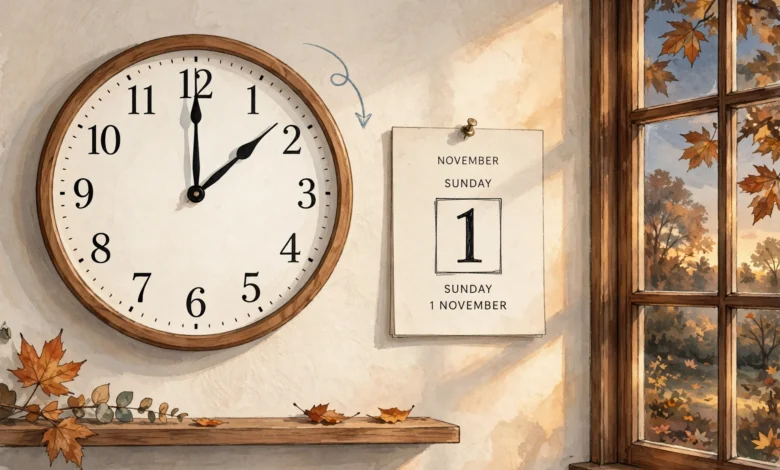
Daylight saving time ends in most of the United States at 2 a.m. local time on Sunday, 1 November 2026, when clocks fall back one hour to 1 a.m. The change arrives the night after Halloween, on Saturday, 31 October, and it returns the country to standard time for the winter. Under federal rules, daylight saving time runs from the second Sunday in March to the first Sunday in November, and 1 November is the earliest date that rule can produce.
Searches for when do clocks go back have surged in the United States ahead of the switch, with many people asking whether the twice-yearly change has been abolished. It has not. No new federal law has taken effect to end the switch, so the November change goes ahead as scheduled.
US Clocks Fall Back — Quick Reference Summary Table
| Detail | What happens |
|---|---|
| End of daylight saving time | Sunday, 1 November 2026 |
| Exact moment | 2 a.m. local daylight time becomes 1 a.m. local standard time |
| Direction | Clocks go back one hour — “fall back” |
| Effect on the day | The 1 a.m. hour repeats, making Sunday a 25-hour day by the clock |
| Daylight shift | An hour of daylight moves from the evening to the morning |
| Places that do not change | Hawaii, most of Arizona, American Samoa, Guam, the Northern Mariana Islands, Puerto Rico and the US Virgin Islands |
| Next spring change | Sunday, 14 March 2027, when clocks move forward one hour |
| UK comparison | The UK already went back on Sunday, 25 October 2026, at 2 a.m. BST to 1 a.m. GMT |
The 2 a.m. moment, explained hour by hour
At 2 a.m. local time on Sunday, the clock returns to 1 a.m. That means the hour from 1 a.m. to 2 a.m. happens twice: once on daylight time, and once on standard time. People who stay up will see 1:59 a.m. followed by 1 a.m. again, rather than 2 a.m.
Most phones, computers and connected devices update automatically. Manual clocks, watches, oven clocks and car clocks still need to be set back by hand. The simplest routine is to turn manual clocks back one hour before bed on Saturday night, so Sunday morning starts on standard time.
The change happens at 2 a.m. local time in each time zone, not at the same instant across the country. New York therefore switches three hours before Los Angeles in elapsed time, even though both switch at their own local 2 a.m.
Who stays on the same time on Sunday
Hawaii and most of Arizona do not observe daylight saving time, so their clocks do not move on 1 November. The Navajo Nation in Arizona does observe it, which creates a split inside the state for the winter months. American Samoa, Guam, the Northern Mariana Islands, Puerto Rico and the US Virgin Islands also do not change.
That matters for calls, flights and broadcasts across state lines. A place that stays on standard time all year will sit an hour closer to, or further from, a neighbouring state after Sunday, depending on the pairing. Checking the time zone, rather than assuming a fixed gap, avoids a missed call or connection.
Why the UK already changed — and why the US date differs
The United Kingdom went back a week earlier, on Sunday, 25 October 2026. At 2 a.m. BST, UK clocks moved back to 1 a.m. GMT, ending British Summer Time. The UK rule is the last Sunday in March forward and the last Sunday in October back, while the US rule is the second Sunday in March forward and the first Sunday in November back.
The two systems therefore drift apart for a week each autumn. During that week, the time gap between London and New York was one hour smaller than usual. From 1 November, with both countries on standard time, the usual five-hour gap between London and New York returns. For other major sports coverage, see Canelo vs Mbilli in Riyadh and Warriors 112-95 Lakers in the NBA Cup, where start times were listed in UK time.
The Sunshine Protection Act: passed in one chamber, not law
The House of Representatives passed the Sunshine Protection Act, H.R. 139, on 14 July 2026 by 308 votes to 117. That bill would make daylight saving time permanent for most states and end the twice-yearly switch. It was then referred to the Senate Committee on Commerce, Science, and Transportation.
As of 31 October 2026, the Senate has not passed the bill and it has not been signed into law. A bill needs both chambers and presidential signature before it changes the clock rules. Until that happens, the existing federal schedule stands, and clocks move forward again on Sunday, 14 March 2027.
Supporters of permanent daylight time argue that ending the switch would remove twice-yearly disruption. Supporters of permanent standard time argue that morning light matters more in winter. Neither position has become law, so Sunday’s change is the rule that applies.
What the darker evenings mean for travel and sleep
The most visible effect on Sunday is earlier sunsets by the clock. An evening that was still light at 6 p.m. on Saturday will be dark at the same clock time on Sunday. Mornings, by contrast, gain light at the same clock time.
Road safety bodies have urged extra care in the first darker evenings, when drivers and pedestrians adjust to lower light at commuting times. Allowing extra time for journeys, checking lights and reflective clothing, and double-checking alarm settings after a manual clock change are practical steps for the first week. The Old Farmer’s Almanac fall-back guide gives the same core advice: set manual clocks back before bed on Saturday, and let connected devices update on their own.
Sleep patterns can also take a day or two to settle, even with an extra hour overnight. Keeping wake-up times steady, rather than shifting the whole day, helps most people adjust faster. The day itself is not shorter — only the clock labels attached to daylight move.
Frequently asked questions
Q: When do clocks go back in the US in 2026?
A: At 2 a.m. local time on Sunday, 1 November 2026, when clocks move back to 1 a.m. local standard time.
Q: Do we gain or lose an hour?
A: We gain an hour. The 1 a.m. hour repeats, so Sunday has 25 hours by the clock.
Q: Do all US states change their clocks?
A: No. Hawaii and most of Arizona do not observe daylight saving time, and neither do American Samoa, Guam, the Northern Mariana Islands, Puerto Rico and the US Virgin Islands. The Navajo Nation in Arizona does observe it.
Q: Has daylight saving time been abolished in the US?
A: No. The Sunshine Protection Act passed the House on 14 July 2026 but has not passed the Senate or been signed into law, so the twice-yearly change continues.
Q: When do US clocks go forward again?
A: On Sunday, 14 March 2027, the second Sunday in March, when clocks move forward one hour at 2 a.m. local time.
Q: When did UK clocks go back in 2026?
A: On Sunday, 25 October 2026, when UK clocks moved back from 2 a.m. BST to 1 a.m. GMT. UK clocks go forward again on Sunday, 28 March 2027.