
Poland Constitutional Tribunal Crisis: Police Deployed as Court Chief Suspended in Warsaw


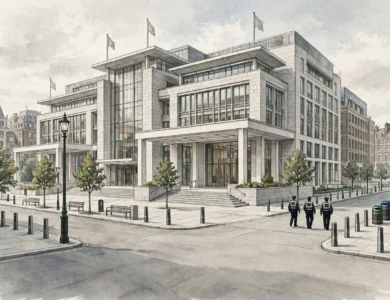
Riot police were deployed outside Poland’s Constitutional Tribunal in Warsaw on Friday night, 30 October 2026, after the suspension of the court’s president sparked protests, competing claims over who runs the institution, and a dramatic return home by President Karol Nawrocki. The Poland Constitutional Tribunal crisis unfolded into the early hours of Saturday, 31 October 2026, as demonstrators gathered outside the building and police said three people were detained after trying to enter the court complex.
Judge Anna Korwin-Piotrowska announced one-month suspensions of Tribunal President Bogdan Święczkowski and Deputy President Bartłomiej Sochański, and said she was assuming responsibility for running the tribunal. The tribunal’s existing leadership rejected that move, with its official account describing it as a coup and insisting that Święczkowski remained president. Police said officers were securing the grounds and had not entered the tribunal building itself.
| Where | Constitutional Tribunal headquarters, Warsaw, Poland |
| When | Friday night, 30 October 2026, continuing into early Saturday, 31 October 2026 |
| Suspended | President Bogdan Święczkowski and Deputy President Bartłomiej Sochański, for one month |
| Announced by | Judge Anna Korwin-Piotrowska, who said she was taking temporary responsibility |
| Police action | Riot police deployed outside the building; three people detained after trying to enter the complex |
| President’s response | Karol Nawrocki turned his plane back from a Senegal trip and returned to Warsaw |
| Government position | Prime Minister Donald Tusk’s government says action is needed to restore the rule of law |
| Opposition position | Law and Justice (PiS) and its allies call the suspensions unlawful and describe them as a coup |
| Next step sought | Justice Minister Waldemar Żurek asked for the two judges’ legal immunity to be lifted |
How a suspension notice turned into a street confrontation
The immediate trigger was the announcement of the suspensions on Friday evening. According to reporting on the announcement, the stated grounds included claims that the two senior judges had obstructed the convening of a general assembly of tribunal judges and that there were violations in the formation of judicial panels. The court’s website went down soon afterwards, leaving the competing statements on social media and in the press as the main public record for hours.
Hundreds of protesters gathered outside the Warsaw building on Friday night. Some demonstrators tried to push through security barriers and, according to police, some threw objects at officers. Police said their deployment followed information from Korwin-Piotrowska about possible threats to judges and staff and risks to public order. The distinction police drew matters: officers said they were securing the grounds, not entering the tribunal building or intervening in its work.
Why Nawrocki turned his plane around
President Karol Nawrocki, an ally of the opposition Law and Justice party, abandoned a trip to Senegal and turned his plane around to return to Poland on Friday. Early on Saturday he reached the tribunal area, where television footage showed him pushing through the crowd to enter the building with Zbigniew Kapinski, described as the court’s first chief justice. Nawrocki later accused the government of violating the Constitution, a charge the government rejects.
The episode exposes Poland’s divided power structure. The prime minister leads the government, while the president holds veto and appointment powers and can act as a check on it. When the two sides disagree over who legitimately controls a constitutional institution, there is no quick referee, and the dispute can spill from legal notices into the street within hours.
A decade-long fight over who controls the court
The Poland Constitutional Tribunal crisis did not begin on Friday night. The tribunal has been a major bone of contention since the Law and Justice government, in power from 2015 to 2023, appointed judges whose legitimacy was disputed by its critics. The current pro-European government under Donald Tusk says decisive action is necessary to restore the rule of law after years of political interference in the court.
Critics of the current government make the opposite argument. PiS leader Jarosław Kaczyński addressed protesters and called on Nawrocki to act, while PiS supporters accused Tusk of trampling on constitutional rights. The European Court of Human Rights, which is separate from the European Union, had already ruled in 2021 that an improperly appointed judge’s participation deprived a company of its right to a tribunal established by law. That history is why both sides now frame the same events in opposite language: restoration of the rule of law on one side, and a coup against judicial independence on the other.
What happens next in Warsaw
Three questions will decide whether the Poland Constitutional Tribunal crisis eases or deepens. First, will the courts or parliament clarify who has the authority to suspend the tribunal’s president, and whether Korwin-Piotrowska can lawfully serve as interim chief without being sworn in by the president? The tribunal’s existing leadership says she cannot, because she has not been sworn in by the president.
Second, will Justice Minister Waldemar Żurek’s request to lift the immunity of Święczkowski and Sochański proceed, opening the way to criminal proceedings against them? That step would raise the stakes from an internal leadership dispute to a criminal process involving the court’s top two judges. Third, will protests continue outside the tribunal, and will police remain deployed around the building through the weekend?
For readers following other fast-moving international stories, the pattern is familiar: a legal decision, a disputed claim of authority, and a public confrontation that tests institutions faster than courts can rule. The G20 family photo was cancelled in Atlanta after ministers refused to stand with Russia’s foreign minister, in another case where protocol broke down in public view. In Britain, the debate over a slavery apology has likewise shown how historical questions can become immediate political tests for a government.
FAQs
What is Poland’s Constitutional Tribunal?
It is Poland’s highest constitutional court. It determines whether laws and other legal provisions comply with Poland’s Constitution, and its rulings can strike down legislation.
Who was suspended in the Poland Constitutional Tribunal crisis?
Tribunal President Bogdan Święczkowski and Deputy President Bartłomiej Sochański were suspended for one month, according to the announcement by Judge Anna Korwin-Piotrowska. The tribunal’s existing leadership disputes the suspension and says Święczkowski remains president.
Why were police deployed outside the court in Warsaw?
Police said they were deployed after information about possible threats to judges and staff and risks to public order. They said officers were securing the grounds and had not entered the tribunal building itself. Three people were detained after trying to enter the court complex.
Why did President Karol Nawrocki return from Senegal?
Nawrocki, a PiS ally, cut short an official trip to Senegal, turned his plane around, and returned to Warsaw on Friday. He later accused the government of violating the Constitution, while the government says its actions are needed to restore the rule of law.
Is the suspension settled law?
No. The authority behind the suspension is itself disputed, including whether Korwin-Piotrowska can serve as interim chief without being sworn in by the president. The competing claims mean the leadership of the tribunal remains contested.



One Comment