
Advanced Base Camp: The Forward Mountain Hub Where an Expedition Changes

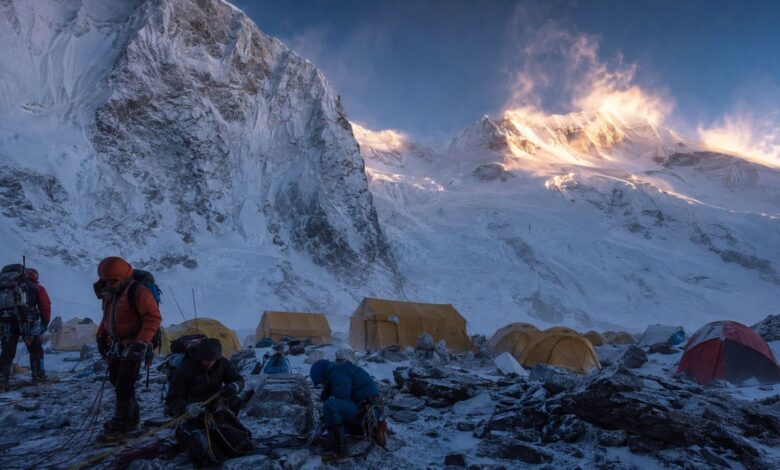
ABC can mean Camp II on Everest, a separate glacier camp on another route, or the boundary where supported trekking gives way to technical climbing.
Advanced base camp sounds like another campsite on an itinerary. It is not. Reaching one can mean leaving the relative security of base camp, crossing glaciers or avalanche terrain, and sleeping at an altitude where the body recovers more slowly.
The name is also deceptively inconsistent. On Mount Everest’s southern route, Camp II functions as Advanced Base Camp. On the northern route, ABC is a separately named camp below the North Col. On Lenin Peak, it sits much lower, at approximately 4,200 metres.
That ambiguity matters. Climbers, trekkers and expedition buyers must understand the exact location, altitude, access requirements and medical implications behind the acronym—not assume that every “ABC trek” represents the same challenge.
Bottom line: An advanced base camp (ABC) is a forward expedition hub established above or beyond the main base camp, closer to the technical climbing route. It supports acclimatization, load storage, cooking, communications and higher-camp operations; its altitude and camp number vary by mountain and route.
Advanced base camp in one operational snapshot
- Full name: Advanced Base Camp
- Common abbreviation: ABC
- Primary role: Forward logistics and acclimatization hub
- Position: Beyond or above the main base camp and closer to the climbing objective
- Fixed altitude: None; the elevation is route-specific
- Typical users: Climbers, guides, high-altitude workers, cooks and load carriers
- Common facilities: Sleeping tents, kitchen or dining shelter, fuel, food, radios and equipment storage
- Typical duration: Multiple nights during acclimatization and summit rotations
- Critical distinction: ABC is a functional designation, not a universal difficulty grade or numbered camp
The label follows the job, not a contour line
An advanced base camp is defined primarily by what it does. It is substantial enough to support repeated climbing operations but positioned farther into the mountain than the principal base camp.
Three characteristics normally distinguish an ABC:
- It is a forward position. The camp shortens the distance between the expedition’s main support centre and its higher objectives.
- It supports repeated operations. Climbers return to it during load carries, acclimatization rotations, route preparation and summit attempts.
- It holds more infrastructure than a normal high camp. Depending on the expedition, that can include cooks, larger tents, communications equipment, stored food, fuel and technical gear.
These characteristics are conventions rather than internationally enforced rules. A team may call a site ABC while another expedition on the same mountain uses a numbered-camp designation.
| Camp type | Main purpose | Typical infrastructure | Relationship to the route |
|---|---|---|---|
| Main base camp | Administration, recovery and major logistics | Larger sleeping, dining, communications and storage facilities | Principal expedition headquarters |
| Advanced base camp | Forward logistics, acclimatization and higher-camp support | Kitchen, sleeping tents, radios, fuel, food and equipment depot | Closer to technical climbing or higher camps |
| Intermediate or numbered camp | Breaks a long ascent into manageable stages | Lightweight tents and limited supplies | May sit below, above or serve as ABC |
| High camp | Final staging point before a summit attempt | Minimal shelter, oxygen and essential equipment | Exposed position close to the summit route |
The naming difference is visible on Lenin Peak. The International Climbing and Mountaineering Federation’s Lenin Peak guide places its advanced base camps at approximately 4,200 metres on glacier moraines. Above ABC, climbers need technical equipment and become substantially more self-sufficient.
That example immediately disproves the idea that every ABC must be near 6,000 metres.
Everest gives one acronym two different meanings
Mount Everest dominates search results for “advanced base camp,” but even there the term does not identify one universal place.
South Everest: Camp II becomes the forward headquarters
On the standard Nepalese southeast-ridge route, climbers begin at Everest Base Camp on or beside the Khumbu Glacier at approximately 5,300–5,364 metres. They then negotiate the Khumbu Icefall, reach Camp I and move through the Western Cwm.
Camp II, established at approximately 6,400 metres, functions as Advanced Base Camp. Expedition descriptions commonly report larger cooking and dining tents, sleeping tents, communications equipment and stored supplies there. It supports operations toward Camp III on the Lhotse Face and Camp IV on the South Col.
The route relationship is therefore:
Everest Base Camp → Khumbu Icefall → Camp I → Camp II/Advanced Base Camp → Camp III → Camp IV/South Col → summit
Camp II is not an extension of the ordinary Everest Base Camp trek. Reaching it requires entry onto the climbing route, glacier travel, fixed-line competence, expedition authorization and passage through the objectively hazardous Khumbu Icefall.
North Everest: ABC is a separately named camp
On the Tibetan northern approach, the main base camp is lower and farther from the technical upper route. Teams traditionally move toward an interim camp and then follow the East Rongbuk Glacier system to Advanced Base Camp at approximately 6,400 metres.
From ABC, the route rises toward the North Col at roughly 7,000 metres and the numbered camps above it. Here, ABC is distinct from Camp I rather than another name for Camp II.
| Mountain and route | Approximate ABC elevation | Naming relationship | Operational purpose |
|---|---|---|---|
| Everest, southeast ridge from Nepal | 6,400 m/21,000 ft | ABC is Camp II | Supports the Lhotse Face, South Col and summit rotations |
| Everest, northeast ridge from Tibet | 6,400 m/21,000 ft | ABC sits below the higher numbered camps | Supports movement toward the North Col |
| Lenin Peak, normal route | 4,200 m/13,780 ft | ABC precedes numbered high camps | Marks the transition toward technical, self-supported climbing |
All elevations are approximate. Camp positions can shift because of glacier movement, snow conditions, crevasses, avalanche exposure and expedition decisions.
What a forward camp must keep functioning
An ABC is less a collection of tents than a carefully positioned supply system. Its usefulness depends on six connected operations.
Site selection under objective danger
Teams need relatively level ground with manageable exposure to avalanches, seracs, rockfall, crevasses, flooding and wind. “Relatively” is crucial: no campsite on an active glacier or beneath steep Himalayan faces can be treated as permanently safe.
Routes and camp platforms may need reassessment throughout a season as snow bridges weaken, glaciers move and temperatures change.
Food, fuel and water
The camp must sustain people who are already burning significant energy in cold, hypoxic conditions. Supplies can include high-calorie food, cooking fuel, snow-melting equipment, water-treatment systems and emergency reserves.
Every meal, gas cylinder and stove component must first be carried there. This makes load planning a central expedition task rather than a minor catering detail.
Shelter and limited recovery
ABC sleeping tents are usually more durable than the minimal shelters placed at high camps. Some large expeditions also establish kitchen, dining, communications and staff tents.
Yet comfort should not be confused with physiological recovery. At extreme altitude, appetite, digestion and sleep can deteriorate. A climber may be resting inside a strong tent while continuing to accumulate fatigue.
Equipment depot
Ropes, anchors, crampons, oxygen systems, tents, fuel and food for higher camps may be staged at ABC. This reduces what climbers must transport from the main base camp during every rotation.
The depot also creates risk. Lost, damaged or poorly inventoried supplies can disrupt the entire upper-mountain schedule.
Communications and weather decisions
Radio or satellite communication connects ABC with the main base camp, higher camps, route-fixing teams and weather support. Leaders use this information to coordinate load carries, manage hazards and decide whether a team should continue, wait or descend.
Sanitation and evacuation planning
Waste, contaminated snow and fuel leakage can turn a heavily used camp into an environmental and health problem. Responsible operators need defined systems for toilets, human-waste removal, rubbish, wastewater and abandoned equipment.
An evacuation plan is equally important. Helicopter access may be restricted or impossible because of altitude, weather, terrain or regulation. Teams must know how an injured or ill person will be stabilized and moved downward.
At 6,400 metres, acclimatization is not immunity
The proportion of oxygen in the atmosphere remains close to 20.9% at altitude. The problem is falling atmospheric pressure: each breath delivers fewer oxygen molecules to the lungs, reducing the partial pressure of oxygen available to the body.
ABC therefore serves as an acclimatization station, but it cannot make extreme altitude physiologically normal. Climbers commonly use rotations: ascend, spend time or sleep higher, descend to recover, and later return.
The CDC Yellow Book’s high-altitude guidance recommends that, once above 3,000 metres, sleeping altitude generally increase by no more than 500 metres per day, with an additional acclimatization day for each 1,000 metres gained. Individual expedition plans must still reflect terrain, prior acclimatization and medical supervision.
Several facts are frequently misunderstood:
- Physical fitness does not provide immunity from acute mountain sickness.
- A person who tolerated one high-altitude trip may react differently to a faster or higher ascent.
- Daytime strength does not guarantee safe sleep at the same altitude.
- Acetazolamide can assist acclimatization when medically appropriate, but it does not replace a controlled ascent.
- Supplemental oxygen can reduce hypoxic stress, but it does not remove avalanche, fall, weather or exhaustion risks.
Symptoms that should stop further ascent
Acute mountain sickness: Headache after recent ascent, commonly accompanied by nausea, dizziness, unusual fatigue, appetite loss or vomiting. A symptomatic climber should not continue to a higher sleeping altitude.
High-altitude cerebral edema: Confusion, loss of coordination, inability to walk normally, altered behaviour or severe drowsiness. This is a medical emergency requiring urgent descent and professional treatment.
High-altitude pulmonary edema: Disproportionate breathlessness, rapidly declining performance, chest congestion, cough or difficulty breathing at rest. Urgent descent and oxygen, when available, are central emergency measures.
An itinerary is a logistics plan—not proof that every participant’s body will adapt on schedule.
The expedition cycle is a rotation, not a straight march upward
A conventional expedition may use ABC through the following sequence:
- Establish the main base camp. Teams organize supplies, practise technical systems and begin altitude adaptation.
- Carry loads forward. Guides and high-altitude workers transport tents, food, fuel, ropes and climbing equipment toward ABC.
- Occupy ABC. Climbers make an initial visit, monitor their response and may sleep there before descending.
- Reach or “tag” a higher camp. The team climbs above ABC, sometimes without sleeping at the highest point reached, and returns lower.
- Recover at base camp or below. Several days of improved food, sleep and oxygen availability help reduce accumulated fatigue.
- Return for the summit rotation. ABC becomes the forward launching point for movement through the remaining camps.
The sequence varies. Weather, route conditions, previous altitude exposure, illness, oxygen strategy and expedition style can shorten, extend or terminate a rotation.
Can a trekker visit an advanced base camp?
The answer is route-specific.
Some ABC approaches are non-technical in favourable conditions and may be included in guided trekking or mountaineering itineraries. Others lie beyond crevassed glaciers, fixed ropes, ladders or permit-controlled climbing zones.
Even a technically straightforward approach can be medically serious. An ABC at 6,400 metres is substantially higher than Everest Base Camp and exceeds the summit elevation of many major mountains. Marketing language such as “trek” must not be interpreted as evidence of low risk.
Before booking, obtain direct answers to these questions:
- Which mountain, side, route and physical campsite does “ABC” describe?
- What is its current approximate sleeping altitude?
- Does ABC share a name with Camp I or Camp II?
- What glacier, rope or climbing skills are required?
- What is the day-by-day acclimatization schedule?
- What permits and current access approvals are necessary?
- What are the turnaround rules for altitude symptoms?
- How will evacuation operate above the main base camp?
- Does insurance cover the maximum planned altitude and activity?
Advanced Base Camp questions people ask before committing
What is an advanced base camp?
An advanced base camp is a semi-permanent forward camp positioned beyond the principal base camp and nearer the technical climbing route. It supports acclimatization, equipment storage, meals, communications and repeated operations toward higher camps. Its location and facilities depend entirely on the mountain, route and expedition strategy.
How high is an advanced base camp?
An advanced base camp has no standard elevation. Everest’s principal ABC sites are commonly placed around 6,400 metres, while Lenin Peak’s normal-route ABC is approximately 4,200 metres. The name describes the camp’s operational role relative to base camp, not a required altitude.
Is Advanced Base Camp the same as Everest Base Camp?
No. Everest Base Camp is the expedition’s main lower headquarters, while Advanced Base Camp is a higher forward hub. On the southern Everest route, Camp II at approximately 6,400 metres serves as ABC. The northern route has its own separately identified ABC at a similar approximate elevation.
Why is Everest Camp II called Advanced Base Camp?
Everest Camp II is called Advanced Base Camp because it performs more than an ordinary overnight camp’s role. Positioned in the Western Cwm, it can contain cooking, dining, sleeping, communications and storage facilities. Teams use it repeatedly while establishing Camp III, Camp IV and preparing for summit attempts.
Is an advanced base camp suitable for beginners?
An ABC is not automatically suitable or unsuitable for beginners because the term does not define technical difficulty. Some approaches are walkable in favourable conditions; others require glacier travel, fixed ropes and expedition experience. Altitude alone can make even a non-technical ABC inappropriate without gradual acclimatization, qualified leadership and emergency planning.
How long do climbers stay at advanced base camp?
Climbers may stay at ABC for one or several nights during each rotation and return multiple times during an expedition. The duration depends on altitude response, weather, route preparation and the summit schedule. At very high ABCs, teams often descend to the main base camp for more effective recovery.
The three letters that reveal an expedition’s real design
ABC is not a standardized rung on a mountain ladder. It is the place where an expedition moves its essential support system forward—closer to the objective, but farther from easy recovery and reliable rescue.
Understanding the term requires four pieces of information: the exact route, physical location, sleeping altitude and operational function. Without them, “advanced base camp” is only a label. With them, it reveals how a team intends to acclimatize, supply the upper mountain, manage danger and return safely.
Sources and verification
- CDC Yellow Book: High-Altitude Travel and Altitude Illness — acclimatization rates, altitude-illness risks and emergency symptoms.
- UIAA: A Climb of Lenin Peak—Normal Route — Lenin Peak ABC elevation, facilities and transition to technical climbing.
- Alpine Ascents International, “Mount Everest Itinerary” — South Everest Camp II/ABC position and expedition function.
- Furtenbach Adventures, “Mount Everest Camps: A Comprehensive Guide” — North and south Everest camp structures and approximate elevations.
Author
- Author: Dr. Marcus Sterling
- Title: Senior Academic Research & Features Writer
- Bio: Dr. Marcus Sterling is an academic researcher and features writer specializing in institutional analysis and educational policy. He translates complex research data into accessible, high-impact journalism for a global audience.
- Editorial disclaimer: Camp elevations and positions are approximate and may change with glacier movement, seasonal conditions, route selection and operator practice. This article provides educational information, not medical or expedition advice. Verify current access rules with the relevant authorities and obtain guidance from qualified high-altitude professionals.