
Space Force Orbital Warship Carrier: The Space-Based Carrier That Could Change Orbital Warfare
The aircraft carrier has dominated oceans for generations; now a very different kind of carrier is being designed to keep spacecraft ready for immediate deployment in orbit.

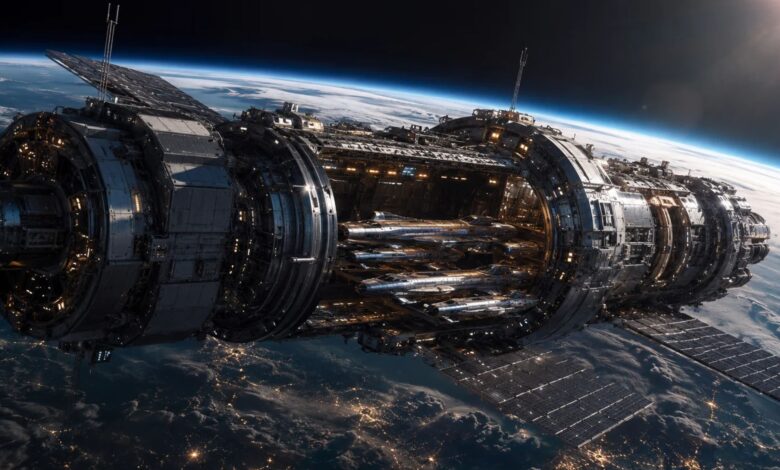
The phrase “Space Force orbital warship carrier” sounds like science fiction, but the underlying technology is already moving beyond the concept-art stage. The U.S. Space Force has backed development of an Orbital Carrier designed to pre-position multiple maneuverable spacecraft in orbit, allowing them to be deployed without waiting for a new launch from Earth.
That distinction matters. The project is not an enormous space battleship carrying fighter jets. It is closer to a mobile orbital staging platform: a spacecraft capable of hosting, protecting, manoeuvring and releasing smaller vehicles when a mission demands rapid action. Gravitics, the company developing the architecture, received a SpaceWERX Strategic Funding Increase (STRATFI) award worth up to $60 million for demonstration and flight activities.
The timing is significant because the U.S. Space Force increasingly treats orbit as a contested military domain. Its doctrine identifies orbital warfare, electromagnetic warfare and cyberspace warfare as the three mission areas supporting space control, while Space Delta 9 is specifically tasked with orbital warfare operations.
For broader context on the service’s mission, see the official U.S. Space Force overview. For related coverage of orbital warfare, responsive space and military space technology, explore the Space Technology section.
BLUF: What the Space Force Orbital Carrier Actually Is
The Space Force Orbital Carrier is a pre-positioned spacecraft platform designed to keep multiple maneuverable space vehicles ready in orbit for rapid deployment. Developed by Gravitics with SpaceWERX support, it is intended to shorten the response time to orbital threats by moving the staging point from Earth into space rather than launching every response vehicle after a crisis begins.
Why “Orbital Warship” Is Useful — and Also Misleading
The term orbital warship is largely an informal description rather than the official name of the system.
The official programme is called the Orbital Carrier. Its carrier analogy comes from the way it can keep smaller spacecraft ready for deployment, rather than from the design of a traditional battleship.
A conventional aircraft carrier provides:
- A forward-deployed operating base
- Storage and maintenance for aircraft
- Command and support infrastructure
- Rapid deployment capability
- Mobility close to areas of strategic interest
The Orbital Carrier applies a related idea to space.
Instead of transporting fighter aircraft, the carrier can pre-position maneuverable spacecraft and mission payloads. Instead of sailing toward a conflict zone, it operates in orbit and uses space mobility to place its hosted vehicles where they are required.
That makes “orbital carrier” the more technically accurate term.
The U.S. Space Force itself describes orbital warfare in terms of combat operations involving fires, movement and manoeuvre. Its 2025 doctrine defines orbital warfare as combat operations conducted through those activities to control the space domain.
The Gravitics Programme Behind the Carrier Concept
The company at the centre of the programme is Gravitics, a U.S. space-infrastructure developer working on large spacecraft structures and orbital logistics.
In March 2025, Gravitics announced that SpaceWERX had selected the company for a STRATFI programme worth up to $60 million. The stated purpose was to demonstrate and fly the Orbital Carrier architecture and develop tactically responsive space capabilities.
The concept developed from an earlier $1.7 million SpaceWERX SBIR contract awarded to Gravitics to adapt its spacecraft architecture for tactically responsive space operations.
By April 2026, Gravitics announced that its Orbital Carrier programme had moved into a further demonstration phase involving the Orbital Carrier Pathfinder and Viper OTX. The company said the programme was intended to increase flexibility for in-space operations by pre-positioning maneuverable vehicles that could be deployed rapidly.
The current development picture
| Element | Current information |
|---|---|
| Programme | Gravitics Orbital Carrier |
| Primary U.S. government partner | U.S. Space Force / SpaceWERX |
| Major funding | Up to $60 million STRATFI |
| Core purpose | Pre-position and rapidly deploy maneuverable spacecraft |
| Operating concept | Tactically responsive space |
| Company | Gravitics |
| Diamondback first-flight target | NET 2027 |
| Medusa first-flight target | NET 2028 |
| Diamondback stated payload | 1 Viper + payload, multiple interceptors or 5–12 m³ flexible volume |
| Medusa stated payload | 6 Vipers + payloads |
Gravitics currently lists Diamondback with a first-flight target of no earlier than 2027 and Medusa with a first-flight target of no earlier than 2028. These are company-published targets, not evidence that either vehicle has already entered operational military service.
Why Pre-Positioning Changes the Orbital Response Equation
Traditional responsive-space thinking often starts with the launch vehicle.
A threat appears. A satellite or spacecraft is required. Engineers prepare the payload. A launch opportunity is secured. The spacecraft reaches orbit. It then has to manoeuvre into its operational position.
An Orbital Carrier attempts to move part of that process before the crisis occurs.
The spacecraft are already in orbit.
That means a future response vehicle does not necessarily begin its journey from a launch pad on Earth. Instead, it could begin from an already-positioned orbital platform.
This is the central strategic proposition behind the technology.
Gravitics describes its carriers as platforms capable of pre-positioning multiple maneuverable vehicles so they can respond to threats, emergencies or time-sensitive opportunities.
The concept therefore addresses a problem that is fundamentally about time.
In an increasingly contested orbital environment, having the right spacecraft may not be enough. The spacecraft may need to be in the right orbit at the right moment.
From Satellite Launches to Orbital Manoeuvre
The development fits into a much broader transformation within U.S. military space operations.
The U.S. Space Force has formally established orbital warfare as a mission area. Space Delta 9, headquartered at Schriever Space Force Base in Colorado, generates forces for full-spectrum orbital warfare and conducts experimentation, technology demonstrations and space-based surveillance activities.
Its responsibilities include close-proximity reconnaissance and resident-space-object characterisation.
That matters because manoeuvring near another spacecraft can serve peaceful purposes such as inspection, servicing or anomaly investigation, but similar technologies can also have military applications.
U.S. Space Force doctrine explicitly recognises the dual-use nature of proximity operations. Technologies developed to rendezvous with, inspect or repair spacecraft can also potentially be used in hostile orbital operations.
The carrier concept sits directly inside this emerging operational problem.
A carrier does not have to be a weapon itself to change military calculations. It can provide the infrastructure from which other spacecraft conduct missions.
Space Domain Awareness Is the Carrier’s Invisible Backbone
A rapid-response spacecraft is only useful if commanders know what is happening around it.
That is why the Orbital Carrier concept cannot be separated from Space Domain Awareness (SDA).
The U.S. Space Force describes SDA as the ability to identify, characterise and understand factors affecting operations in space. Space Delta 2 supports this mission by tracking objects and building a common understanding of the national-security space environment.
The scale of the tracking challenge is enormous.
Space Delta 2’s published figures include:
- 44,700 tracked space objects
- 8,900 active payloads
- 16,600 analyst objects
- 19,200 pieces of orbital debris
Those numbers are subject to change as objects are catalogued, reclassified and added to tracking systems.
The U.S. Space Force also upgraded its Ground-Based Optical Sensor System at the Maui Space Surveillance Complex in 2026. The service said the upgrade doubled field of view, doubled search speed and more than tripled sensitivity, improving detection of small or difficult-to-observe objects across MEO, GEO, HEO and cislunar orbits.
The relationship is straightforward:
Better awareness → faster decision-making → more useful orbital manoeuvre → greater value from pre-positioned spacecraft.
The Carrier Is Not a Giant Battleship
One of the biggest misconceptions surrounding the Space Force orbital carrier concept is the assumption that the U.S. military is preparing a gigantic, heavily armoured spacecraft resembling a science-fiction battleship.
That is not what the publicly available programme describes.
The Orbital Carrier is better understood as orbital infrastructure with mobility and deployment functions.
Its potential roles can include:
- Hosting smaller spacecraft
- Pre-positioning manoeuvrable vehicles
- Rapid deployment
- Space-domain-awareness missions
- Proximity operations
- Inspection
- Emergency response
- Logistics
- Missile-defence-related applications
- Other time-sensitive space missions
Gravitics has described the architecture as supporting multiple mission categories rather than a single weapons function. Its 2026 corporate filings also describe potential applications spanning national security, space logistics and commercial orbital infrastructure.
That makes the word carrier more important than warship.
The system’s strategic value comes from what it can carry, position and deploy.
The 2025–2028 Development Timeline
2023 — The design foundation
Gravitics received a $1.7 million SBIR contract connected to SpaceWERX to develop the Orbital Carrier concept for responsive space applications.
March 2025 — Major Space Force backing
SpaceWERX selected Gravitics for a potential $60 million STRATFI award to demonstrate and fly the Orbital Carrier.
2025 — Space warfare doctrine expands
The U.S. Space Force published its first Space Warfighting framework defining counterspace operations across orbital warfare, electromagnetic warfare and cyberspace warfare.
April 2026 — Demonstration architecture advances
Gravitics announced further development involving the Orbital Carrier Pathfinder and Viper OTX, describing the effort as a step toward greater flexibility in contested orbital operations.
2027 — Diamondback target
Gravitics currently lists NET 2027 as the first-flight target for its Diamondback Orbital Carrier configuration.
2028 — Medusa target
The company lists NET 2028 as the first-flight target for the Medusa configuration, designed to accommodate multiple Viper vehicles and payloads.
These dates should be treated as development targets, not guaranteed deployment dates.
What Could an Orbital Carrier Actually Carry?
Public information does not establish a final operational payload configuration for the entire programme.
Gravitics’ current public material does, however, describe different carrier configurations.
The Diamondback is listed with capacity for one Viper plus payload, multiple interceptors, or a flexible internal volume of approximately 5–12 cubic metres.
The Medusa is listed with capacity for six Vipers plus payloads.
This distinction is important because the carrier architecture is not necessarily tied to one particular spacecraft.
The carrier could function as a platform, while the mission-specific vehicle provides the actual operational capability.
That architecture could potentially allow the same orbital infrastructure to support different missions over its service life.
The Golden Dome Connection Needs Careful Reading
The Orbital Carrier has also become associated with discussions around space-based missile defence and the broader Golden Dome programme.
Gravitics’ 2026 SEC filings describe the company’s Orbital Carrier strategy as potentially supporting space-based missile defence and state that the company had been selected by a defence prime contractor to build three flight-ready Orbital Carriers for a Golden Dome-related programme. These statements are company disclosures and should not automatically be interpreted as confirmation of an operational U.S. Space Force deployment.
That distinction matters.
There is a significant difference between:
- A company developing a technology for a defence requirement.
- A government-funded demonstration.
- A prototype entering flight testing.
- A production contract.
- An operational military capability.
The Orbital Carrier has clearly progressed beyond a purely fictional concept because it has received government-backed development funding. But its ultimate operational role remains dependent on testing, acquisition decisions, mission requirements and government authorisation.
What Makes the Concept Strategically Different?
The central advantage is persistence.
A conventional launch system can provide exceptional flexibility, but it still depends on Earth-based infrastructure, launch preparation and orbital insertion.
A pre-positioned carrier changes the starting point.
Instead of:
Earth → launch → orbit → manoeuvre → mission
the carrier concept seeks to enable:
Orbit → select vehicle → deploy → manoeuvre → mission
That does not eliminate launch requirements. The carrier itself must first reach orbit, and its hosted vehicles must be delivered there.
But once deployed, the carrier can potentially create a persistent reserve of spacecraft already above Earth.
This is why the concept fits naturally into the Space Force’s broader interest in Tactically Responsive Space.
The Hard Problems Are Still in Orbit
The technology is promising, but an orbital carrier would face serious engineering and operational constraints.
Propellant
Moving spacecraft between orbital regimes requires energy. A carrier that constantly manoeuvres or repeatedly deploys vehicles must carry sufficient propulsion capability or rely on vehicles with their own propulsion systems.
Survivability
A carrier containing multiple spacecraft becomes a potentially valuable target.
Concentrating assets in one platform can create efficiency, but it can also create risk if an adversary can locate, track or disable the carrier.
Detection
The more active a carrier becomes, the more likely its manoeuvres may generate observable signatures.
Command and control
Rapid deployment requires secure communications, accurate tracking and timely authorisation.
Debris
Any destructive engagement in orbit carries the possibility of creating debris that can threaten friendly and commercial spacecraft.
Cost
Large spacecraft are expensive to launch, test, maintain and replace. A carrier architecture must prove that its operational advantages outweigh those costs.
These challenges explain why the U.S. Space Force is simultaneously investing in space domain awareness, resilient architectures and counterspace capabilities rather than relying on one spacecraft programme.
Why the Carrier Fits the Space Force’s 2040 Thinking
The Space Force’s 2026 Operational Framework for Doctrine describes space control as the effort required to contest and control the space domain.
It also rejects the idea that permanent dominance of space is necessarily realistic. Instead, the framework emphasises maintaining freedom of action, generating decisive effects and denying adversaries freedom of action for operationally relevant periods.
That philosophy fits an orbital carrier surprisingly well.
The objective is not necessarily to maintain one gigantic spacecraft permanently over every strategic location.
The objective is to create responsive options.
A carrier can potentially give commanders another option between two extremes:
- Waiting for a new spacecraft to launch from Earth.
- Maintaining an enormous number of individual spacecraft permanently in every possible orbit.
The carrier sits between those models.
People Also Ask: Is the Space Force Building a Space Battleship?
Is the Space Force building a space battleship?
No. The publicly disclosed programme is an Orbital Carrier, not a giant battleship. It is being developed by Gravitics with SpaceWERX support to pre-position and deploy smaller maneuverable spacecraft. The carrier analogy refers to its ability to act as an orbital staging platform rather than to a traditional battleship carrying weapons and crew.
What is the Space Force Orbital Carrier?
The Space Force Orbital Carrier is a proposed spacecraft platform designed to keep multiple maneuverable vehicles ready in orbit. Its purpose is to reduce the time required to respond to emerging orbital threats or urgent missions by positioning spacecraft before they are needed. Gravitics is developing the architecture under SpaceWERX-backed programmes.
How much is the Orbital Carrier programme worth?
The major SpaceWERX STRATFI award announced in 2025 was worth up to $60 million for Gravitics’ Orbital Carrier development, demonstration and flight activities. The figure represents the potential value of the programme rather than the price of a completed operational carrier fleet.
When could the first Orbital Carrier launch?
Gravitics currently lists NET 2027 as the first-flight target for its Diamondback configuration and NET 2028 for Medusa. These are company-published targets and can change as development and testing progress.
Can an Orbital Carrier deploy weapons?
The architecture is intended to support multiple mission types, and public Gravitics material references interceptors, counterspace operations and missile-defence applications. However, the exact operational payloads and rules governing their use are not fully established in publicly available technical information. Claims about specific future weapons should therefore be treated as proposed capabilities rather than confirmed operational systems.
Why does the Space Force want spacecraft already in orbit?
Pre-positioning can reduce the delay between detecting a problem and deploying a response vehicle. The Space Force’s emphasis on tactically responsive space reflects the need for faster orbital options as space becomes more contested and as adversaries develop increasingly capable counterspace systems.
The Bigger Shift: Space Warfare Is Becoming a Mobility Problem
The most consequential part of the Orbital Carrier story may not be the carrier itself.
It is the changing military assumption behind it.
For decades, satellites were often treated as relatively fixed infrastructure: launch them, place them into an assigned orbit and operate them from the ground.
Modern military space operations are moving toward something more dynamic.
Spacecraft can manoeuvre.
They can inspect other objects.
They can reposition.
They can host payloads.
They can potentially perform proximity operations.
And military planners increasingly consider movement and manoeuvre essential elements of orbital warfare.
The Orbital Carrier takes that idea one step further by creating a potential forward-deployed reserve of manoeuvrable spacecraft.
That is a profound change in how a military force could think about orbit.
The Line Between Infrastructure and Weapon Is Getting Thinner
An aircraft carrier is not merely a ship.
It is an entire operational ecosystem.
The same principle could apply in orbit.
A carrier can provide the platform. Smaller vehicles provide the manoeuvre. Sensors provide awareness. Communications provide command and control. Ground systems provide intelligence and authorisation.
The resulting system is therefore bigger than one spacecraft.
That is why the Space Force’s broader architecture matters more than the “warship” label.
Its official mission structure already links space domain awareness, orbital warfare, electromagnetic warfare, cyberspace operations and battle management.
An orbital carrier could become one physical node within that larger network.
The Strategic Question Washington Still Has to Answer
The Orbital Carrier solves one problem elegantly: how to keep response vehicles closer to the battlefield before the battlefield becomes active.
But it introduces another.
If the carrier becomes valuable enough to protect, it becomes valuable enough to target.
That creates a strategic trade-off between concentration and distribution.
A single carrier could simplify logistics and command.
A dispersed constellation could improve resilience.
Future U.S. space architecture will likely need both approaches: large platforms where they provide genuine efficiency, and distributed systems where survivability matters more.
The Space Force’s own doctrine points toward that kind of hybrid architecture, emphasising resilient command and control, government-allied-commercial integration and multiple counterspace capabilities rather than a single dominant platform.
The Orbit Ahead Is Less About Bigger Ships Than Faster Decisions
The Space Force Orbital Warship Carrier is not yet the science-fiction battleship its nickname suggests.
The real story is more consequential.
The U.S. Space Force is backing a technology designed to keep manoeuvrable spacecraft already in orbit, ready for deployment when circumstances demand it. Gravitics’ Orbital Carrier programme has moved from an earlier $1.7 million development contract to a potential $60 million STRATFI effort and into a demonstration architecture with publicly stated flight targets beginning in 2027.
If the technology works as intended, the most important advantage will not be firepower.
It will be time.
In an orbital conflict, the side that detects an emerging threat first, understands it accurately and can place the right spacecraft in the right orbit fastest may gain the decisive advantage.
That makes the Orbital Carrier less a futuristic warship than something arguably more useful: a forward-deployed mobility and response system for a contested space domain.
Sources & Verification
- U.S. Space Force — Space Force overview and core functions: official information on space superiority, orbital warfare, electromagnetic warfare, space battle management and space domain awareness.
- U.S. Space Force Combat Forces Command — Mission Delta 9: official description of orbital warfare forces, experimentation and close-proximity space operations.
- U.S. Space Force Doctrine Document 1, 2025: official doctrine defining orbital warfare as combat operations through fires, movement and manoeuvre.
- U.S. Space Force — 2040 Operational Framework for Doctrine: official discussion of space control, counterspace operations and future force structure.
- Gravitics — Orbital Carrier STRATFI announcement: company announcement concerning the potential $60 million SpaceWERX programme.
- Gravitics — 2026 Orbital Carrier demonstration update: company announcement concerning Pathfinder and Viper OTX development.
- Gravitics — Orbital Carrier programme information: current public specifications and first-flight targets for Diamondback and Medusa.
- U.S. SEC filings: company disclosures concerning Gravitics’ contracts, markets and stated defence applications.
Editorial Disclaimer
This article distinguishes confirmed government information, company disclosures and forward-looking development claims. Flight dates, future payload configurations, defence applications and programme outcomes can change. References to potential military capabilities should not be interpreted as confirmation that a system is currently operational or authorised for a particular mission.