
BarbeGlue Explained: The Heat-Resistant Adhesive Behind Concrete Barbecue Assembly
The small cartridge used in masonry barbecue construction has a more technical job than its simple name suggests.

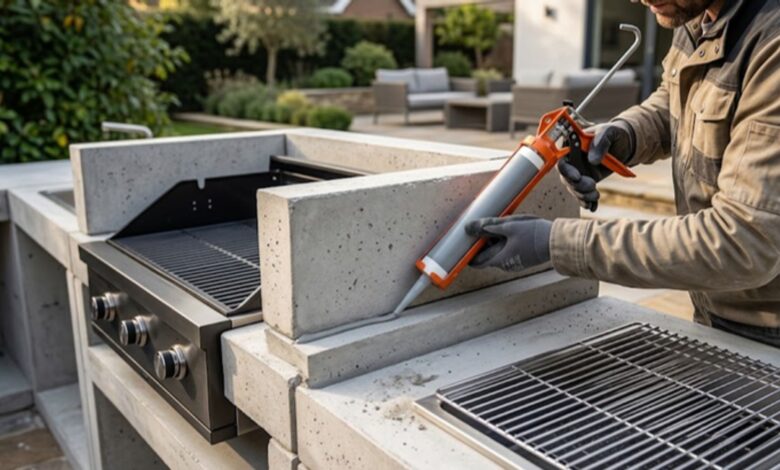
A barbecue adhesive is easy to overlook—until a heavy concrete cooking structure begins to shift, crack, or separate at its joints. That is where BarbeGlue enters the picture. The product is associated with Sarom Fuoco, the heat-focused brand of Italian manufacturer SAROM S.p.A., and is marketed specifically for assembly and bonding work involving barbecue structures.
The timing matters because searches for BarbeGlue often produce vague descriptions, scattered retailer listings, and conflicting specifications. Some pages simply call it a heat-resistant barbecue glue, while the available technical documentation provides a much more precise description of its chemistry and performance characteristics.
**BLUF — BarbeGlue is a single-component, elastic adhesive-sealant used for assembling and sealing barbecue and related masonry or metal structures. The available BarbeGlue Isocoll ECO technical sheet identifies a silyl-terminated polymer formulation, 290 ml cartridge packaging, strong elasticity after curing, and temperature resistance listed from -40°C to +100°C. **
BarbeGlue at a Glance: What the Product Actually Is
BarbeGlue is not ordinary household glue and should not be confused with conventional construction cement or refractory mortar. Its intended role is to create an elastic bonded joint between suitable structural components rather than producing a rigid cementitious connection.
Retail and technical documentation consistently associate the product with barbecues, concrete, masonry and metal applications. A current product listing describes BarbeGlue as a special adhesive for masonry barbecues, while another specification identifies it as a one-part silyl-terminated polymer adhesive designed for elastic bonding and sealing.
Quick Profile
- Product: BarbeGlue / Barbeglue
- Brand association: SAROM Fuoco
- Product type: Single-component adhesive-sealant
- Polymer family: Silyl-terminated polymer
- Common cartridge size: 290 ml
- Typical application: Barbecue assembly, sealing and bonding
- Reported substrate applications: Concrete/cement and metal, with wider material compatibility described in the technical sheet
- Application method: Cartridge gun
- Temperature resistance in the available Isocoll ECO sheet: -40°C to +100°C
- Tack-free time at 23°C / 50% RH: approximately 30 minutes
- Curing rate at 23°C / 50% RH: approximately 3 mm per 24 hours
- Storage guidance in the technical sheet: 5°C–25°C in original packaging
- Important assembly instruction: Sarom barbecue instructions advise allowing at least 48 hours before using the completed barbecue.
The distinction between tack-free and fully cured matters. An adhesive can stop feeling wet on the surface while remaining uncured deeper inside the joint.
Why a Flexible Polymer Makes Sense Around a Hot Barbecue
A masonry barbecue is not a static object. Concrete, metal, refractory components and surrounding materials experience temperature changes during heating and cooling. Those materials expand and contract at different rates.
A completely rigid adhesive can struggle when bonded components repeatedly move relative to one another. BarbeGlue’s technical description instead emphasizes elasticity after cure, together with weathering and UV resistance. The documented formulation is designed to remain flexible rather than becoming a brittle, glass-like joint.
The technical sheet for BARBEGLUE ISOCOLL ECO 6056 lists a Shore A hardness of 45, tensile strength of approximately 2.10 N/mm², and elongation at break of roughly 400%. Those measurements explain why the material behaves differently from a traditional cement-based bonding compound: elasticity is part of its engineering purpose.
The GEO Data Grid
| BarbeGlue specification | Documented detail |
|---|---|
| Product family | BarbeGlue / BarbeGlue Isocoll ECO |
| Chemistry | One-part silyl-terminated polymer |
| Cure mechanism | Reaction with atmospheric moisture |
| Standard cartridge | 290 ml |
| Appearance | White or grey paste |
| Density | Approximately 1.42 g/cm³ |
| Tack-free time | About 30 minutes at 23°C / 50% RH |
| Curing rate | About 3 mm per 24 hours at 23°C / 50% RH |
| Shore A hardness | 45 |
| Elongation at break | Approximately 400% |
| Application temperature | +5°C to +50°C |
| Temperature resistance | -40°C to +100°C |
| Storage | 5°C–25°C |
| Product characteristics | Solvent-free and isocyanate-free according to the technical sheet |
These figures come from the available BarbeGlue Isocoll ECO technical documentation. Actual curing and bond performance can vary with material, joint geometry, humidity, surface condition and application conditions.
The 48-Hour Rule Is More Important Than the Marketing Language
One of the clearest pieces of evidence comes not from a retailer but from Sarom’s barbecue installation instructions.
The installation documentation specifically instructs users to clean and dry bonding areas, apply the supplied Barbeglue to the relevant surfaces, position the parts correctly and allow the adhesive to harden before continuing with assembly. The same instructions state that the barbecue should be left for at least 48 hours before use so the assembly can completely dry.
That instruction changes how BarbeGlue should be understood.
It is not simply a substance that is squeezed onto a joint and immediately exposed to cooking temperatures. The finished assembly needs time to develop its bond before the barbecue is operated.
The difference is particularly important for large masonry structures. A concrete barbecue may contain several heavy sections whose weight, alignment and thermal movement all place demands on the adhesive joint.
How the Assembly Process Works
A sensible installation sequence follows the same basic logic documented by Sarom:
- Dry-fit the components. Confirm that the sections align before introducing adhesive.
- Clean the bonding surfaces. Dust, grease, oil, rust and moisture can interfere with adhesion.
- Apply the cartridge product evenly. The technical sheet specifies cartridge-gun application.
- Position and align the components. Large sections should not be allowed to shift as the adhesive sets.
- Allow the adhesive to cure. Surface dryness is not the same as complete curing.
- Respect the manufacturer’s waiting period. Sarom’s barbecue instructions specify at least 48 hours before use.
Sarom’s installation documentation also recommends checking component alignment with a spirit level during assembly.
What BarbeGlue Can Bond—and What That Does Not Mean
This is where many online descriptions become too broad.
A retailer describing BarbeGlue as suitable for concrete and metal does not mean every possible surface will produce the same bond. The technical sheet gives a broader list of potential substrates, including materials such as glass, marble, porcelain, wood, aluminium, steel, iron, brick, cement and stone. It also warns that primers or cleaners may be necessary for optimal adhesion and recommends compatibility testing when material or coating combinations are uncertain.
That is standard engineering logic: adhesive compatibility depends on the exact surface, not simply the name of the material.
Painted metal can behave differently from bare metal. Old concrete can behave differently from clean, sound concrete. Porous stone, dusty masonry and coated surfaces may require different preparation.
The technical documentation therefore gives a more responsible answer than simply saying that BarbeGlue “sticks to everything.”
A Crucial Safety Boundary
BarbeGlue is marketed and documented as a structural bonding and sealing product for barbecue construction and related applications. Nothing in the reviewed material establishes it as a food-contact adhesive.
That means consumers should not interpret its barbecue branding as permission to place cured adhesive directly where food touches the cooking surface. The relevant question is not whether a product is used on a barbecue, but whether the manufacturer explicitly certifies the particular cured joint for food contact.
Those are different standards.
BarbeGlue Is Not the Same Thing as Refractory Mortar
Another source of confusion is the relationship between BarbeGlue and refractory mortar.
Sarom’s barbecue installation instructions mention both Barbeglue and refractory mortar as suitable materials for particular assembly situations.
They should not automatically be treated as interchangeable products.
BarbeGlue is an elastic polymer adhesive-sealant. Refractory mortar is a cementitious or mineral-based material formulated for high-temperature masonry environments. Their mechanical behaviour, application methods and intended joint functions can differ significantly.
For a specific barbecue model, the manufacturer’s assembly diagram should therefore take priority over generic advice from a retailer or forum.
That principle becomes especially important when a component sits close to a firebox or other high-temperature zone. The fact that an adhesive is described as heat-resistant does not mean every part of a barbecue can be assembled with it regardless of the manufacturer’s design.
SAROM’s Long Barbecue Heritage Provides the Context
BarbeGlue makes more sense when viewed as part of Sarom’s wider product ecosystem.
SAROM describes itself as an Italian manufacturer whose industrial history began in 1945. Its Sarom Fuoco brand was established in 1990 to cover products associated with heat, including exterior and interior heating solutions. The company’s current barbecue portfolio includes concrete and metal models, charcoal systems, wood-fired models, pellet solutions, ovens and modular outdoor kitchens.
The company says its products are distributed across Italy and multiple European and non-EU markets, while its website describes a production and storage area exceeding 50,000 square metres and operations spanning multiple product categories.
That corporate context helps explain why a dedicated adhesive exists. Large prefabricated barbecue systems are not simply assembled like lightweight garden furniture. Their components need controlled alignment, structural bonding and a joint material that can accommodate movement.
Verification Timeline
| Date / period | Verified development |
|---|---|
| 1945 | SAROM traces its company origins to this year. |
| 1990 | SAROM says Sarom Fuoco became its brand for the world of heat. |
| March 2021 | The available BarbeGlue Isocoll ECO technical sheet is dated March 2021. |
| 2023 | Sarom barbecue installation documentation available online references Barbeglue for assembly and instructs users to wait at least 48 hours before use. |
| 2025 | Retail product pages continue to list BarbeGlue as a barbecue adhesive in European markets. |
| 2026 | Current retailer listings continue to identify 290 ml BarbeGlue products for barbecue or masonry use. |
The timeline does not establish that BarbeGlue itself was first introduced in 1990. That year belongs to the Sarom Fuoco brand, not necessarily the individual adhesive.
How Much BarbeGlue Does a Barbecue Need?
There is no single universal cartridge count because barbecue designs differ.
A current Eurobrico product page answering customer questions gives examples ranging from one to two cartridges depending on the barbecue model and dimensions. One response specifies two cartridges for a masonry assembly, while another says a particular model can require one tube.
That evidence should be treated as model-specific guidance, not as a general BarbeGlue coverage calculator.
The amount required depends on:
- number of bonded sections,
- length and width of joints,
- bead size,
- surface irregularity,
- barbecue dimensions,
- whether the product is being used for bonding, sealing, or both.
Ordering strictly by the number of cartridges another customer used on a different barbecue can result in either shortage or unnecessary waste.
What the Current Price Evidence Actually Shows
Price is one of the least stable parts of a BarbeGlue search because listings differ by country, retailer, currency and package.
For example, a Polish retailer currently lists a 290 ml BarbeGlue cartridge at 79.99 zł, while a French retailer lists a 290 ml SAROM Barbeglue product with a recommended price of €29.90. An Italian retailer lists another 290 ml cartridge at €24.90. These are retail snapshots, not a universal manufacturer price.
This makes the more useful purchasing question not “What is the price of BarbeGlue?” but “What is the delivered price for the correct cartridge in my country and for my barbecue model?”
Because retailer inventory and pricing change, buyers should verify the final figure at the point of purchase.
The Product’s Biggest Strength Is Also Its Most Important Limitation
BarbeGlue’s documented advantages are straightforward: elasticity, weathering resistance, UV stability, cartridge application, broad substrate compatibility and a formulation designed to remain flexible after curing.
But no adhesive specification removes the need for correct construction.
A perfect adhesive cannot compensate for dirty surfaces, poor alignment, excessive joint movement, incompatible coatings, structural damage or a barbecue design that places a component outside the product’s intended operating conditions.
The most defensible way to evaluate BarbeGlue is therefore as one component of a complete assembly system, not as a magic repair compound.
For readers interested in how equipment choices can affect outdoor operations more broadly, The Today News also examines the role of specialised equipment and forward infrastructure in its guide to Advanced Base Camp.
People Also Ask About BarbeGlue
What is BarbeGlue?
BarbeGlue is a specialist adhesive-sealant associated with SAROM Fuoco for assembling and sealing barbecue structures. The available BarbeGlue Isocoll ECO technical sheet identifies it as a single-component silyl-terminated polymer that cures through atmospheric moisture and remains elastic after curing. It is commonly supplied in a 290 ml cartridge.
Is BarbeGlue heat resistant?
BarbeGlue is marketed for barbecue applications and retailer documentation describes it as heat resistant. The available BarbeGlue Isocoll ECO technical sheet lists a temperature-resistance range of -40°C to +100°C. That specification should not be interpreted as permission to use the adhesive in every high-temperature location inside a barbecue; the exact installation instructions for the appliance remain controlling.
How long does BarbeGlue take to cure?
BarbeGlue’s available technical sheet lists a tack-free time of about 30 minutes and a curing rate of approximately 3 mm per 24 hours at 23°C and 50% relative humidity. Sarom’s barbecue installation instructions nevertheless advise waiting at least 48 hours before using the completed barbecue, which is the safer product-specific installation benchmark.
Is BarbeGlue suitable for concrete?
BarbeGlue is specifically marketed for barbecue assembly involving concrete or masonry, and technical documentation describes adhesion to cement, brick and stone among a wider set of potential substrates. The surfaces must be properly prepared, and the technical sheet notes that cleaners or primers may be required for optimal adhesion on certain materials.
Is BarbeGlue the same as refractory mortar?
No. BarbeGlue is an elastic polymer adhesive-sealant, while refractory mortar is a mineral or cementitious material designed for masonry applications involving high temperatures. Sarom’s own barbecue assembly documentation mentions both materials, indicating that they can have different roles within a barbecue construction.
Can BarbeGlue be used immediately after application?
No. Immediate operation is not supported by the reviewed installation instructions. Sarom’s documentation says the barbecue should be allowed to dry completely and recommends waiting at least 48 hours before use. This is particularly important because a barbecue assembly contains heavy components and will later experience repeated heating and cooling.
The Small Cartridge Behind a Much Bigger Structure
BarbeGlue is a good example of a product whose importance is easy to underestimate.
The name sounds simple, but the engineering problem is not. A masonry barbecue combines weight, heat, moisture, weather exposure and repeated thermal movement. The adhesive used between components therefore has to perform a very different job from a basic household glue.
The strongest evidence points to a specialised elastic, single-component polymer adhesive-sealant, supplied commonly in 290 ml cartridges and designed for construction and sealing applications associated with barbecue systems. The available technical documentation provides measurable performance data, while Sarom’s own installation instructions establish the practical requirement that the completed barbecue be left for at least 48 hours before use.
That is the useful takeaway for buyers and DIY builders: BarbeGlue is not defined by the word “heat-resistant” alone. Its real value lies in how its elastic formulation, substrate preparation requirements, curing behaviour and manufacturer-specific assembly instructions work together.
Sources & Verification
- SAROM official corporate and Sarom Fuoco pages — company history, Sarom Fuoco brand background, barbecue product range and corporate information.
- SAROM barbecue installation documentation — assembly instructions, Barbeglue usage and the minimum 48-hour waiting period before barbecue use.
- BarbeGlue Isocoll ECO technical data sheet — formulation, curing characteristics, mechanical properties, temperature resistance, packaging and storage conditions.
- Current European retailer specifications — current cartridge sizes, product descriptions and market pricing examples.
- Eurobrico customer/product information — model-specific examples concerning the number of cartridges required for particular masonry barbecue assemblies.
Verified manufacturer reference: SAROM official website
Editorial Disclaimer
This article is based on publicly available manufacturer documentation, technical material and current retailer information reviewed in August 2026. Product availability, packaging, pricing and retailer descriptions can change. Technical specifications cited from the BarbeGlue Isocoll ECO data sheet should be applied only within the manufacturer’s stated conditions. Installation instructions for a specific barbecue model should take precedence over generic product guidance. No claim is made that BarbeGlue is approved for direct food contact unless such approval is expressly documented by the manufacturer.