
Cellulogia Explained: What This Often-Misunderstood Cellulite Treatment Really Does
The name sounds like a science of the cells—but in practice, Cellulogia usually points to a specific body-treatment technique whose claims need a closer look.

Cellulite is one of those cosmetic concerns that refuses to follow the rules people expect. It can appear in people who are slim, active and otherwise healthy. It commonly affects the thighs, hips and buttocks, and it can remain visible despite exercise, weight changes and an expensive skincare routine. MedlinePlus describes cellulite as fat beneath the skin that creates a dimpled appearance, with connective-tissue structure, genetics, hormones and other factors influencing who develops it.
That is why the term Cellulogia has attracted attention. Search results increasingly frame it as a wellness philosophy, a natural cellulite solution or even a broad approach to skin health. But those descriptions blur an important distinction: in professional cosmetology literature, cellulogia is also used to describe vacuum-assisted mechanical massage or lipomassage, including techniques built around rollers and suction.
The terminology matters because the evidence for a massage-based cosmetic improvement is not the same as evidence for permanently removing cellulite.
BLUF: Cellulogia is best understood as a cosmetic cellulite-treatment term commonly associated with vacuum-assisted mechanical massage, lipomassage or related tissue-manipulation techniques. It may temporarily improve the appearance, smoothness or firmness of cellulite-prone skin, but it is not a medically established cure for cellulite and should not be marketed as permanent fat removal.
The word “Cellulogia” has two lives
A major reason for confusion is that Cellulogia is not a universally standardized medical diagnosis or pharmaceutical treatment name.
In some contemporary wellness articles, the word is presented as a broad philosophy combining exercise, nutrition, hydration, skincare and non-invasive body care. That usage is largely editorial and commercial rather than a formally standardized clinical definition.
In Polish cosmetology and academic material, however, cellulogia is used much more concretely. A university medical publication describes cellulogia, or lipomassage, as a vacuum massage designed to firm skin and subcutaneous tissue, using a treatment head with moving rollers connected to suction.
A Polish Commission for Academic Evaluation report also lists Cellulogia among modern cosmetology equipment and procedures used in practical training, alongside vacuum lifting, radiofrequency, mesotherapy and other cosmetic technologies.
So when someone searches for “Cellulogia treatment,” they may be encountering two different concepts:
| Search meaning | What it generally refers to | Evidence position |
|---|---|---|
| Cellulogia as a wellness concept | Lifestyle, skincare, exercise and non-invasive cellulite care | Broad and non-standardized |
| Cellulogia as a cosmetic procedure | Vacuum massage, rollers, mechanical tissue manipulation or lipomassage | Some evidence for short-term cosmetic improvement |
| Cellulogia as a “cure” | Claims of permanently eliminating cellulite | Not supported |
| Cellulogia as permanent fat removal | Claims that massage destroys or permanently removes fat deposits | Misleading |
The safest interpretation is therefore procedural: Cellulogia usually means a mechanical, suction-assisted cosmetic approach to cellulite rather than a single drug or medical cure.
Why cellulite appears even when body weight is normal
The first mistake in judging Cellulogia is assuming that cellulite is simply excess fat.
It is not that simple.
MedlinePlus explains that everyone has subcutaneous fat, including people who are thin. Cellulite develops when the relationship between fat deposits and the connective fibres anchoring the skin creates visible dimpling. Genetics, hormones, body composition and other factors can influence how pronounced that pattern becomes.
Research literature similarly describes cellulite as a structural problem involving the dermis, subcutaneous fat and fibrous septa beneath the skin. In a clinical study of a vacuum-assisted tissue-release device, investigators described cellulite as the dimpled appearance created where fibrous septa tether the dermis to deeper tissue.
That explains why “just lose weight” is an inadequate answer.
It also explains why a surface treatment can change appearance without changing the underlying anatomy permanently.
Cellulogia works on appearance, not a magical “cellulite switch”
Vacuum massage changes how the skin and superficial tissues are mechanically manipulated. Depending on the device and protocol, the treatment may combine:
- Negative pressure or suction
- Mechanical rolling
- Repeated tissue compression and release
- Massage of the subcutaneous region
- Temporary changes in fluid distribution
- Local stimulation of circulation
A cosmetology text describing cellulogia/lipomassage specifically identifies the moving rollers and suction head as central components of the procedure.
That gives the technique a plausible mechanism for temporarily changing tissue appearance.
It does not, by itself, prove that the procedure permanently destroys the fibrous structures responsible for cellulite.
What a Cellulogia session actually looks like
The exact protocol depends on the machine and practitioner, but the basic treatment pattern is recognizable.
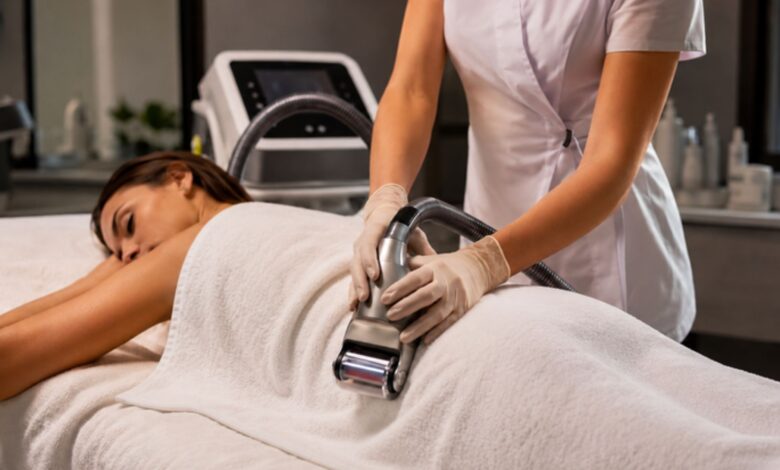
A practitioner applies a mechanical treatment head over cellulite-prone areas, commonly the thighs, hips or buttocks. Vacuum pressure pulls a fold of skin and superficial tissue into the device while rollers or another mechanical component manipulate the tissue.
The goal is cosmetic: improve the visual appearance of uneven skin and, depending on the protocol, create a firmer or smoother feel.
A professional academic description of lipomassage reports that the technique uses a special head with moving rollers connected to a suction tube, while related endermologie procedures use electronically controlled rollers operating together with negative pressure.
Some modern devices combine massage and vacuum with other technologies such as radiofrequency or infrared energy. Those combinations should not automatically be treated as identical to Cellulogia. Their evidence base is different because the treatment is no longer simple mechanical massage.
This distinction is crucial when comparing clinics.
A package labelled “Cellulogia” might mean vacuum massage alone. Another clinic might use the same commercial label for a device combining suction, rollers, radiofrequency or infrared energy.
The name on the brochure does not tell you the complete treatment technology.
What the evidence can—and cannot—prove
There is real research into mechanical and vacuum-based cellulite treatments, but the results need to be interpreted carefully.
The American Academy of Dermatology notes that endermologie, a vacuum-like deep-massage treatment available in spas, has produced mixed study results. Some studies reported improvement, while others found no meaningful difference compared with controls. Where improvement occurs, the AAD notes that it is generally temporary and cellulite may return after treatment stops.
That is a much more cautious conclusion than the “permanent cellulite removal” language sometimes used in promotional material.
Research on combination technologies has produced encouraging findings, but these studies do not automatically validate every Cellulogia treatment.
For example, a PubMed-indexed controlled study evaluated a device combining radiofrequency, infrared light and mechanical tissue manipulation in 20 women with moderate bilateral thigh and buttock cellulite. The researchers reported clinical improvement after eight treatments, but the technology tested was a specific combined device—not generic massage alone.
Another randomized study involving 102 women examined a specific low-level laser plus massage system and compared it with massage alone. The treatment group showed measurable changes, but again, the evidence concerns that particular technology and protocol rather than the word “Cellulogia” as a universal treatment category.
A separate 55-person study of vacuum-assisted precise tissue release found substantial improvement lasting to one year, but that procedure used a medical device designed to release fibrous septa and should not be confused with ordinary vacuum massage.
The evidence hierarchy matters
A useful distinction is:
Massage can change appearance. Releasing fibrous septa is a different intervention. Permanently removing cellulite is an even stronger claim.
That is why a before-and-after photograph should never be treated as proof that every Cellulogia procedure produces permanent anatomical change.
What results can realistically look like?
The most defensible expectation is cosmetic improvement rather than eradication.
Possible short-term effects can include:
- Smoother-looking skin
- A temporary reduction in visible dimpling
- A firmer sensation in treated areas
- Changes in superficial fluid distribution
- Temporary improvement in skin texture
Professional sources caution that results from vacuum-based massage can be temporary. The American Academy of Dermatology specifically reports that endermologie results vary and that any benefit may disappear after treatment is discontinued.
That makes maintenance an important part of the business model for many cosmetic massage treatments.
A clinic promising that a short course will “destroy cellulite forever” is making a significantly stronger claim than the available evidence supports.
A realistic Cellulogia results grid
| Question | Evidence-based reading |
|---|---|
| Can it improve skin appearance? | Yes, some studies and professional sources report improvement |
| Can the skin look smoother temporarily? | Possible |
| Does it permanently eliminate cellulite? | Not established for generic vacuum massage |
| Does it necessarily remove body fat? | No |
| Can results vary by person? | Yes |
| May maintenance sessions be needed? | Yes |
| Is every “Cellulogia” machine the same? | No |
The newest evidence makes one thing especially clear
One 2026 PubMed-indexed study examined vacuum massage using Chinese cupping in 10 young women with grade-2 lipodystrophy. Eleven treatments were performed over three weeks, with changes reported in hydration, elasticity and smoothness.
That study is interesting, but it is also small.
Ten participants cannot establish that the technique works consistently across different ages, skin types, cellulite severity levels and treatment settings. It also reinforces a larger point: massage-based procedures may change measurable skin characteristics without proving permanent elimination of cellulite.
For consumers, the correct takeaway is neither “Cellulogia is fake” nor “Cellulogia is a guaranteed cure.”
The evidence sits somewhere in between.
What Cellulogia is not
The marketing language surrounding cellulite often becomes blurred with unrelated concepts. Several claims deserve particular caution.
Cellulogia is not the same as liposuction. Liposuction physically removes fat but is not recommended as a standard treatment for cellulite because removing fat does not address the fibrous tethering responsible for dimpling and may sometimes make the appearance more obvious.
Cellulogia is not automatically a medical procedure. Many forms are cosmetic treatments performed in beauty or aesthetic settings.
Cellulogia is not a guaranteed detox treatment. Claims that massage “flushes toxins” are much broader than the evidence required to establish a medical detoxification effect.
Cellulogia is not a weight-loss method. A change in body contour after massage should not automatically be interpreted as fat loss.
Cellulogia is not a substitute for dermatological assessment. Persistent, painful or unusual skin changes deserve medical evaluation rather than a cosmetic treatment package.
Who should be careful before booking?
Vacuum-based treatments can be inappropriate for some people depending on the device, pressure level, medication history and medical circumstances.
A qualified provider should ask about relevant health conditions, medications and previous procedures rather than immediately selling a package.
Extra caution is sensible when there is unexplained swelling, significant vascular disease, active skin inflammation, open wounds, recent surgery or other conditions that could make mechanical pressure unsuitable.
The American Academy of Dermatology also highlights treatment-specific concerns with certain cellulite procedures and stresses that different technologies have different evidence and risks.
The right question is not merely, “Does Cellulogia work?”
It is:
“What exact device and mechanism is this clinic using, what evidence exists for that device, and what outcome should I realistically expect?”
A smarter way to judge a Cellulogia clinic
Before paying for a multi-session package, ask for the machine name and treatment protocol.
Then check whether the practitioner can explain:
- Whether the treatment uses vacuum alone or vacuum plus RF, infrared, laser or another technology.
- What cellulite outcome is being measured.
- How many sessions are normally recommended.
- How long the expected improvement is supposed to last.
- What side effects are possible.
- Whether before-and-after photographs are standardized.
- Whether the claimed evidence actually studied the same device.
This is especially important because “Cellulogia” is not a single regulated technology with one universally agreed protocol.
A branded machine, a vacuum massage system and a minimally invasive tissue-release procedure should never be treated as interchangeable.
For a broader look at why wellness credentials and medical expertise should not be conflated, see The Today News’ profile of Ines de Ramon, which distinguishes a reported integrative nutrition health-coaching qualification from medical or clinical credentials.
Frequently Asked Questions About Cellulogia
What is Cellulogia?
Cellulogia is a cosmetic term commonly associated with vacuum-assisted mechanical massage or lipomassage used to improve the appearance of cellulite. Depending on the clinic, it may involve rollers, suction or additional technologies. It is not a universally standardized medical treatment and should not automatically be interpreted as a permanent cellulite cure.
Does Cellulogia really work?
Cellulogia can produce visible cosmetic improvement in some people, but the strength and duration of the effect depend on the exact technique used. Evidence on vacuum massage and endermologie is mixed, and the American Academy of Dermatology reports that improvements can be temporary. Stronger results from specialized devices cannot be generalized to every treatment marketed as Cellulogia.
Is Cellulogia permanent?
Cellulogia is not proven to permanently eliminate cellulite when the term refers to vacuum massage or mechanical lipomassage. Cellulite is influenced by the underlying arrangement of connective tissue, dermis and subcutaneous fat. Improvements produced by massage may fade, meaning some people require maintenance treatments.
Can Cellulogia remove fat?
Cellulogia should not be marketed as equivalent to surgical fat removal. Mechanical massage can alter the appearance and feel of treated tissue, but that does not establish permanent removal of fat cells. Treatments combining massage with laser, radiofrequency or other technologies must be assessed separately because their mechanisms and evidence differ.
How many Cellulogia sessions are needed?
There is no universal Cellulogia session schedule because the term covers different protocols and devices. Published studies of related vacuum and combination treatments have used regimens ranging from several sessions to multi-week courses. The correct number depends on the device, treatment intensity, target area and intended result rather than a single standard Cellulogia rule.
Is Cellulogia safe?
Cellulogia can be tolerated as a non-invasive cosmetic treatment, but safety depends on the exact machine, pressure, technique and the individual being treated. Vacuum-based procedures may cause temporary discomfort or bruising, and some medical conditions can make cosmetic pressure treatments inappropriate. A qualified practitioner should screen clients before treatment.
The useful truth behind the Cellulogia hype
Cellulogia is neither a miracle nor a meaningless buzzword.
There is a real cosmetic procedure behind the term, especially in European cosmetology, where cellulogia can describe vacuum-assisted massage and lipomassage. There is also a newer internet usage that stretches the word into a much broader wellness philosophy.
The evidence supports a measured interpretation.
Mechanical massage can influence the appearance of cellulite. Some combination technologies can produce more substantial clinical changes. Specialized tissue-release procedures can address structural components of cellulite more directly. But those treatments are not interchangeable, and none of that evidence turns the word “Cellulogia” into a universal medical cure.
The most important consumer decision is therefore not whether the label sounds scientific.
It is whether the specific treatment, device and promised outcome are supported by evidence.
Sources & Verification
- American Academy of Dermatology — Cellulite treatments: What really works?
- MedlinePlus — Cellulite
- PubMed — Combined radiofrequency, infrared light and mechanical tissue manipulation
- PubMed — Laser, vacuum and massage for cellulite
- PubMed — Vacuum-assisted precise tissue release
- PubMed — 2026 study of vacuum massage and skin characteristics
- Polska Platforma Medyczna — Cellulogia/lipomassage description
Editorial Disclaimer: This article distinguishes established cellulite science from broader wellness and cosmetic marketing language. Cellulogia may refer to different procedures depending on the provider and device. Individual results, risks and suitability vary. Medical concerns should be assessed by an appropriately qualified healthcare professional rather than a cosmetic practitioner alone.