Riemann Hypothesis Proof Claim: Anthropic Mathematician Says Claude Helped Solve 167-Year-Old Problem

Levent Alpöge, a mathematician at Anthropic in San Francisco, claimed on Friday 20 November 2026 that he had proved the Riemann hypothesis with help from the Claude large language model, posting a four-page note and a computer-checked formal proof on his personal website. Hours later, Stanford mathematics professor Ravi Vakil released a second, entirely human-written proof claim by postdoctoral researcher Alessandro Masullo, who says he spent twelve years on the same problem. Neither claim has been independently verified as correct, and outside experts say the decisive checks on both arguments are still under way.
The twin announcements explain why “Riemann hypothesis” surged on Google Trends on Saturday 21 November 2026, with 100K+ searches in the United States, 20K+ in the United Kingdom and Canada, and 5K+ in Australia. Alpöge wrote, “I believe I have, working with Claude, discovered a proof of the Riemann Hypothesis,” and said the same method also settles the broader Generalized Riemann Hypothesis. Nature reported the claim on 20 November 2026 and noted that Anthropic had not responded immediately to a request for comment.
Riemann Hypothesis — Quick Reference Summary
| Item | Verified detail |
|---|---|
| Problem | Riemann hypothesis, proposed by Bernhard Riemann in 1859 |
| Subject | Distribution of prime numbers via zeros of the Riemann zeta function |
| Claim 1 (AI-assisted) | Levent Alpöge (Anthropic) with Claude, posted Friday 20 November 2026; Lean formalization in 14-part archive |
| Claim 2 (human-only) | Alessandro Masullo (Stanford postdoc), twelve years of work; released Friday 20 November 2026 by Ravi Vakil |
| Broader claim | Both claims extend to the Generalized Riemann Hypothesis, which would also settle the original hypothesis |
| Verification status | Not publicly verified as proved; community checks on statements, definitions and arguments still pending |
| Prize | Clay Mathematics Institute Millennium Prize, $1 million, subject to publication, two-year wait and general acceptance |
| Market timing | Anthropic shares began trading on Nasdaq on Thursday 19 November 2026, one day before the announcement |
Two Claims Landed Hours Apart on Friday
Alpöge’s note appeared on Friday morning, one day after Anthropic’s stock-market debut. He released Lean code split across a 14-part archive, together with a timeline he says Claude assembled, showing months of work steered toward the Riemann problem since 6 October 2026 with several key steps dated 15 November 2026. There is no conventional journal paper yet, and Alpöge says a full natural-language write-up ran past 250,000 pages, which he chose not to publish.
While number theorists were still downloading those files, Vakil posted Masullo’s manuscript, titled The Music of the Primes. Vakil, who serves as president of the American Mathematical Society, said Stanford number theorist Brian Conrad had been reviewing Masullo’s argument closely for months and that it had held up so far. The original plan had been to polish the draft quietly for a year, but Alpöge’s post made that timetable untenable, so Vakil released the current draft and asked the community to check it.
What Bernhard Riemann Asked About Prime Numbers in 1859
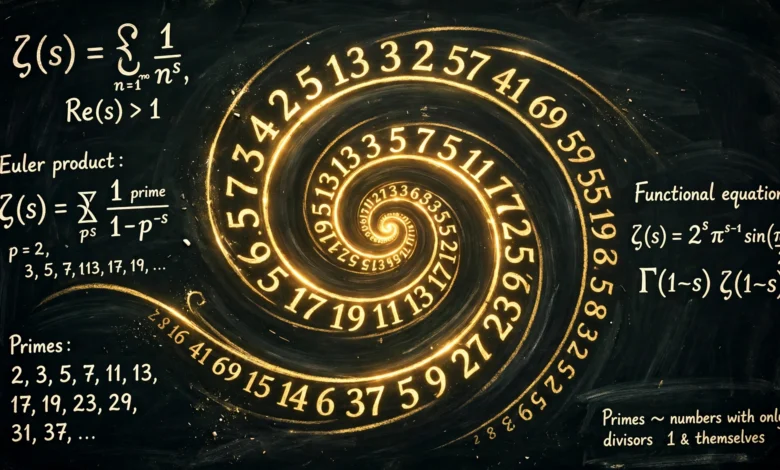
Prime numbers — 2, 3, 5, 7, 11 and onward — look irregular as they appear along the number line. In 1859, German mathematician Bernhard Riemann showed that their spacing is controlled by a function now called the Riemann zeta function, written ζ, and specifically by the points where that function equals zero. His hypothesis states that every non-trivial zero lies on a single vertical line in the complex plane, with real part exactly one-half.
The statement has been checked numerically for the first ten trillion zeros without finding a counterexample. A general proof for all zeros has resisted mathematicians for 167 years, which is why the conjecture became the central open question in number theory. Scientific American described the conjecture as the North Star of the field and noted that most leading experts spent little time on it because no clear route to a proof was visible.
How the Claude-Assisted Lean Proof Is Built to Be Checked
Lean is a formal proof assistant that verifies whether each logical step follows from the previous one. If the code compiles, the chain of deductions holds inside the system, which removes one familiar risk: a gap hidden in prose that readers miss. MIT mathematician Andrew Sutherland told Scientific American he had independently compiled Alpöge’s result in Lean and called the moment historic, while adding that understanding the mathematical details would still take substantial work.
Compilation alone does not settle the claim. Checkers must still confirm that the final theorem in the code matches the standard Riemann hypothesis and that every definition underneath it, starting with the zeta function itself, is the genuine object rather than a convenient lookalike. Alpöge is candid about that gap: he says he is presenting a complete argument before having mastered all the mathematics around it, directed the approach throughout, and is now catching up on parts where Claude moved faster than he could follow.
The Twelve-Year Human Manuscript Released the Same Day
Masullo’s route is different in method and in review history. His manuscript is a long human-written argument built over twelve years with no AI involvement at any stage, according to Vakil’s account. Because the Generalized Riemann Hypothesis covers a wider family of functions that includes the Riemann zeta function as the simplest case, a correct proof of the generalized statement would also settle Riemann’s original question.
That wider scope is also what Alpöge claims for the Claude-assisted argument, which he says covers Dirichlet L-functions without added assumptions. The two proofs therefore overlap in what they claim to settle, but early readers describe different machinery underneath: Alpöge’s files draw on heavy automorphic methods, while Masullo’s draft follows a separate human lineage. If both survived scrutiny, mathematicians would gain two independent routes to the same result; if only one survived, the other would still be examined as a near-miss.
| Feature | Alpöge with Claude | Masullo (human-only) |
|---|---|---|
| Released | Friday 20 November 2026, personal website note | Friday 20 November 2026, hours later via Ravi Vakil |
| Form | Four-page note plus Lean formalization, 14-part archive | Long human-written manuscript, The Music of the Primes |
| Time claimed | Months of directed work since 6 October 2026 | Twelve years |
| Prior review | Seen by few outside Anthropic before release | Months of detailed review by Brian Conrad |
| Scope claimed | Riemann hypothesis and Generalized Riemann Hypothesis | Generalized Riemann Hypothesis (implies Riemann hypothesis) |
| Status on 21 November 2026 | Not publicly verified as proved | Not publicly verified as proved |
Why Outside Experts Have Not Called Either Proof Settled
Reactions so far split between excitement and caution. Oxford number theorist James Maynard, a Fields Medal winner, said a fully checked proof would clearly mark a historic milestone in mathematics. Hector Pasten of the Pontifical Catholic University of Chile said a correct and understood proof would complete a dictionary between branches of mathematics where connections were only partial, while Concordia University professor Carlo Pagano said the new ideas could open fresh avenues in number theory if the argument holds.
Other specialists pressed on presentation and timing. Andrew Granville of the University of Montreal called Alpöge’s four-page document garbled and argued that a clearer write-up should have come first, linking the release date to Anthropic’s share-price drop on 19 November 2026 after an initial valuation of $1.5 trillion. Alpöge answered that reading directly, writing that any cynical view about announcing to help the stock price is false, and said he alone decided not to wait longer after consulting company leadership about constraints on timing.
Background progress this year makes the claims harder to dismiss outright. In August 2026, an experimental Claude system improved a longstanding bound on zeros on the critical line from 41.6% to 67.2%, and in October 2026 an OpenAI results release made further progress on prime distribution. Even so, specialists stress that first checks on definitions and statements could take days or weeks, and a readable, accepted proof would take far longer.
What a Verified Proof Would Unlock — and What It Would Not Change
A confirmed proof would instantly validate hundreds of results that mathematicians have proved conditionally by assuming the hypothesis over the past century and a half. The generalized version would unlock a larger pile of waiting theorems across number theory. That payoff is intellectual rather than commercial in the near term: researchers agree the result has no immediate application that would change banking systems or internet speed.
The $1 million Clay prize would not follow quickly either. Clay Mathematics Institute rules require a solution to appear in a qualifying publication, wait at least two years after publication, and win general acceptance in the mathematics community before the institute considers an award, placing any prize in 2028 at the earliest and more likely 2029. For Anthropic, the announcement landed one day after its Nasdaq debut on Thursday 19 November 2026, drawing market attention, but neither Anthropic, Stanford nor the Clay Institute had issued a confirming statement by 21 November 2026.
One popular fear can be set aside on current evidence. RSA encryption depends on the difficulty of factoring a large number that is the product of two primes, and a proof about how primes are distributed does not make that factoring task easier. Cryptographers have also assumed the generalized hypothesis for decades in security arguments, so a proof would confirm an assumption already in use rather than expose a new shortcut to private keys.
Questions Readers Are Asking About the Two Announcements
Has the Riemann hypothesis been proved?
Not publicly verified as proved as of Saturday 21 November 2026. Two independent claims were posted on Friday 20 November 2026, but outside experts have not yet confirmed that either argument proves the standard statement. Headlines calling the problem solved run ahead of the community checks still in progress.
Who are Levent Alpöge and Alessandro Masullo?
Alpöge is a number theorist employed by Anthropic who says he directed Claude through months of work toward the proof. Masullo is a Stanford postdoctoral researcher who says his human-only manuscript reflects twelve years of work. Further biographical details such as exact ages were not needed for this report and are not publicly verified here.
What does Lean verification actually guarantee?
Lean checks that each formal step follows logically from earlier steps, so a compiling proof cannot contain a hidden logical gap inside its own definitions. It does not by itself guarantee that those definitions match the standard zeta function or that the final theorem states the Riemann hypothesis in its accepted form. Human number theorists must verify that match.
Will a proof break online banking or encryption?
No, on the evidence reported so far. The hypothesis concerns how primes are spread along the number line and how closely their count tracks a smooth formula. Factoring the specific large numbers used in RSA keys remains a separate hard task, and the recognised threat to RSA is a large-scale quantum computer running Shor’s algorithm, not a proof of this conjecture.
When would the $1 million prize be paid?
Not soon, even if a proof holds. The Clay Mathematics Institute requires qualifying publication, a wait of at least two years, and general acceptance by the mathematics community. Any award consideration would fall in 2028 at the earliest.
Why did both proofs appear on the same day?
Masullo’s draft had been under private review for months with a plan to circulate it quietly after further polishing. Vakil said Alpöge’s Friday announcement made waiting untenable, so he released the current manuscript the same day and invited public checking. The two teams were not reported to have worked together.