Roy Broadbent and Doreen Broadbent: The Quiet Theatre Makers Who Shaped Jim Broadbent’s Career
Before Jim Broadbent became an Oscar-winning actor, he was raised inside an unusual Lincolnshire world where art, theatre, pacifism and community life were woven together.

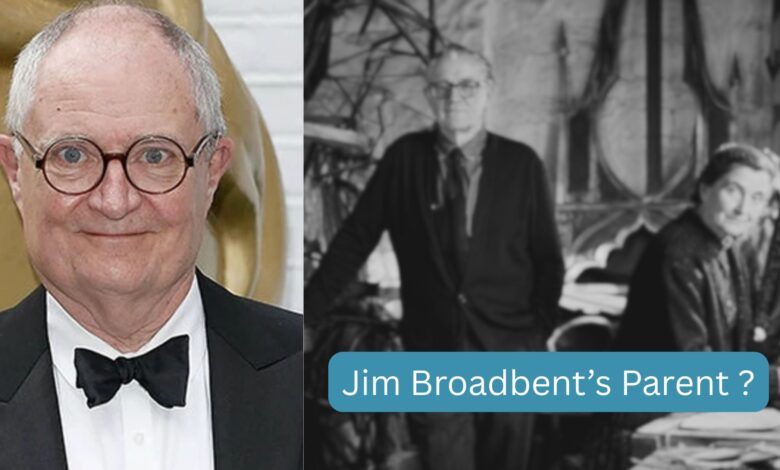
Jim Broadbent is widely recognised for films such as Iris, Moulin Rouge!, Topsy-Turvy, Bridget Jones’s Diary and Harry Potter and the Half-Blood Prince. Yet the story behind the actor begins well away from London studios and Hollywood premieres. It starts in rural Lincolnshire, where his parents, Roy Broadbent and Doreen “Dee” Findlay, built an artistic community that gave their son an early relationship with performance.
Roy was an artist, sculptor, interior designer and furniture maker, while Doreen was a sculptor and amateur actress. Together they helped establish the Holton Players, a theatrical group that grew out of a community of conscientious objectors who settled in and around Holton-cum-Beckering during and after the Second World War.
That background matters because Jim Broadbent did not discover acting in isolation. He grew up around people making things, staging plays and treating theatre as part of everyday community life. His parents’ influence was not simply genetic; they created the environment in which performance became normal.
Roy Broadbent and Doreen “Dee” Findlay were the parents of actor Jim Broadbent, born in Holton-cum-Beckering, Lincolnshire, in 1949. Roy was an artist, sculptor, interior designer and furniture maker; Doreen was a sculptor and amateur actress. Both helped found the Holton Players, the community theatre group whose later work led to the Broadbent Theatre.
The Broadbent family snapshot
| Detail | Verified information |
|---|---|
| Father | Roy Laverick Broadbent |
| Mother | Doreen “Dee” Findlay Broadbent |
| Jim Broadbent’s birth | 24 May 1949 |
| Birthplace | Holton-cum-Beckering, Lincolnshire |
| Roy’s professions | Artist, sculptor, interior designer, furniture maker |
| Doreen’s work | Sculptor and amateur actress |
| Theatre connection | Both were founder members of the Holton Players |
| Major memorial | Broadbent Theatre, Wickenby |
| Roy’s lifespan | 1915–1972 |
The family details are supported by biographical records and the historical material maintained by the Broadbent Theatre organisation.
Roy Broadbent: the artist who turned a chapel into a theatre
Roy Broadbent was born in 1915 and became a prominent figure in Lincolnshire’s amateur arts community. The Broadbent Theatre’s own historical archive describes him as a sculptor and interior designer, as well as a talented amateur character actor. His work was exhibited locally at Lincoln’s Usher Art Gallery and in London.
His artistic interests were broader than sculpture. Roy trained toward architecture and became involved with the conscientious-objector community during the Second World War. Historical material about the Holton community records his involvement in land-based work alongside other pacifists who rejected military service.
The Holton Players emerged from that environment. Roy and Dee were among its founders, alongside other artistically minded members of the community. Theatre was initially informal: musical evenings, poetry, play readings and performances became a form of shared entertainment in a village with limited electricity and few conventional sources of organised recreation.
Roy’s practical skills later became critical to the group’s survival. When a Methodist chapel at Wickenby became available in 1970, the players bought it and began converting it into a theatre. The Broadbent Theatre’s historical account credits Roy with playing a central role in the conversion, supported by resources from Roy and Douglas Ballard.
Roy did not live to see the theatre fully establish itself. He died in 1972, aged 57, shortly after the building had opened. The players subsequently named the venue the Broadbent Theatre in his memory.
Broadbent Theatre official history
Doreen “Dee” Broadbent was more than Jim Broadbent’s mother
Doreen “Dee” Findlay Broadbent has generally received less individual biographical attention than her husband, but the surviving records make her role in the family’s artistic life clear.
Biographical sources identify her as a sculptor and amateur actress. Together with Roy, she was a founder member of the Holton Players.
The theatre archive also records Dee taking part in productions. Its surviving production documentation lists “Dee Broadbent” in the cast of Still Life and credits her with costumes for a production of The Threepenny Opera. Those records provide a more concrete picture of her contribution: she was not merely associated with the theatre through marriage, but participated directly in its creative work.
That distinction is significant when considering Jim’s upbringing. Both parents occupied artistic roles, but neither treated theatre as an exclusively professional pursuit. Their work connected sculpture, design, acting, costumes and local community performance.
The wartime community that became Jim Broadbent’s first stage
The Holton Players did not begin as a conventional professional theatre company. They grew from an unusual wartime settlement in Lincolnshire.
The Broadbent Theatre’s historical record describes a group of conscientious objectors who worked on the land around Holton-cum-Beckering. Instead of military service, members of the community pursued agricultural work while maintaining a strong cultural life. The group held musical gatherings, read plays and performed for one another.
After the war, the players acquired an RAF Nissen hut and converted it for theatrical performances. That building eventually burned down, forcing the group to find another way to continue. The later purchase and conversion of the Wickenby Methodist chapel provided a more permanent home.
This history helps explain the unusual circumstances of Jim Broadbent’s childhood. He was not simply the son of two artists who happened to enjoy theatre. He grew up in a community where theatre was physically built by neighbours, performed by local residents and integrated into rural social life.
Several biographies also report that Broadbent made an extremely early stage appearance in one of his parents’ productions, including accounts placing his childhood debut in a production of Henrik Ibsen’s A Doll’s House.
Also Read About Jim Broadbent’s Wife
The theatre Roy left behind became a permanent family link
The Broadbent Theatre is perhaps the clearest surviving monument to Roy and Dee’s contribution.
Located on Snarford Road in Wickenby, Lincolnshire, the venue is now operated by Lindsey Rural Players. The organisation states that the players originated from the Holton Players founded by Roy and Dee and other members of the wartime community.
The building opened as a theatre in 1970 after the former Methodist chapel was converted. Roy died soon afterwards, and the venue was named the Broadbent Theatre as a memorial to him.
The theatre’s first recorded production was Noah in November 1972, illustrating how quickly the group moved from Roy’s building project into its next chapter.
The venue remains tied directly to Jim Broadbent. The Broadbent Theatre describes him as president of the Lindsey Rural Players, continuing a family association that began with his parents’ work decades earlier.
Visit Lincolnshire — Broadbent Theatre history
Why Roy and Dee matter to the Jim Broadbent story
It is tempting to reduce celebrity family history to a simple question of inheritance: did an actor’s parents make him artistic? Roy and Dee’s story suggests something more interesting.
Jim Broadbent was born into an environment where artistic activity was practical rather than glamorous. His father’s work involved designing spaces, making furniture and sculpture, while both parents participated in amateur theatre. The family therefore existed at the intersection of visual art, craftsmanship and performance.
That foundation sits naturally alongside Broadbent’s later career. After initially studying art, he moved toward acting and eventually entered the London Academy of Music and Dramatic Art, graduating in 1972. His professional career then developed through theatre before expanding into television and film.
His later success was his own achievement, but the setting in which he first encountered theatre was unmistakably shaped by Roy and Dee.
The strongest evidence of their influence is not a famous quote from the family. It is the physical theatre they helped create and the community performances they made possible.
What can actually be verified about Roy and Doreen’s finances?
There are no reliable public financial records establishing Roy Broadbent’s personal wealth, property portfolio or annual income, and similarly detailed financial information for Doreen “Dee” Broadbent is not publicly established by the authoritative sources reviewed for this article.
Claims online assigning a specific net worth to either parent should therefore be treated cautiously. Roy’s recorded professions and exhibitions demonstrate an active artistic career, but they do not provide enough evidence to calculate a defensible modern equivalent of his wealth.
For Doreen, the surviving evidence is stronger on her artistic and theatrical involvement than on commercial earnings.
Authoritative financial metrics for Roy Broadbent and Doreen Broadbent are currently unverified and unavailable. Any precise net-worth figure presented without primary financial documentation would be speculative.
A concise timeline of the family’s theatre legacy
| Period | Event |
|---|---|
| 1915 | Roy Laverick Broadbent is born |
| Second World War years | Roy, Dee and other conscientious objectors establish an artistic community around Holton-cum-Beckering |
| Wartime period | The Holton Players develop through readings, music and theatre |
| Post-war years | The group uses an RAF Nissen hut for performances |
| 1960 | The Nissen hut theatre is destroyed by fire |
| 1969 | The Lindsey Rural Players are formed in the aftermath of renewed local theatrical activity |
| 1970 | A former Methodist chapel in Wickenby is acquired and converted into a theatre |
| 1972 | Roy Broadbent dies aged 57; the theatre is named in his memory |
| November 1972 | Noah becomes the first recorded production at the Broadbent Theatre |
| 24 May 1949 | Jim Broadbent is born in Holton-cum-Beckering and later follows his parents into performance |
The timeline draws principally on the Broadbent Theatre’s historical archive and biographical sources covering Jim Broadbent’s early life.
People Also Ask about Roy Broadbent and Doreen Broadbent
Who were Jim Broadbent’s parents?
Jim Broadbent’s parents were Roy Laverick Broadbent and Doreen “Dee” Findlay Broadbent. Roy was an artist, sculptor, interior designer and furniture maker, while Doreen was a sculptor and amateur actress. Both were founder members of the Holton Players in Lincolnshire.
What did Roy Broadbent do for a living?
Roy Broadbent was an artist, sculptor, interior designer and furniture maker. He also worked as an amateur actor and played a major role in establishing the Holton Players. The Broadbent Theatre archive records his exhibitions and his involvement in designing and converting the Wickenby chapel into a theatre.
Who was Doreen “Dee” Broadbent?
Doreen “Dee” Broadbent, née Findlay, was Jim Broadbent’s mother. She was a sculptor and amateur actress and co-founded the Holton Players with Roy Broadbent. Theatre records also document her participation in productions and costume work, confirming her active role in the group’s creative life.
Did Roy and Doreen Broadbent run a theatre?
Roy and Doreen were founder members of the Holton Players rather than operators of a conventional commercial theatre. The group eventually acquired a former Methodist chapel at Wickenby in 1970 and converted it into a theatre. The venue was later named the Broadbent Theatre after Roy’s death in 1972.
Where did Jim Broadbent grow up?
Jim Broadbent was born in Holton-cum-Beckering, Lincolnshire, on 24 May 1949. He grew up in the artistic community surrounding his parents and their theatre activities before later attending school in Reading and moving to London for drama training.
Did Jim Broadbent’s parents influence his acting career?
Yes. Roy and Doreen created an environment in which acting and other forms of art were part of everyday life. Both were involved with the Holton Players, and biographical accounts report that Jim appeared on stage as a child. He later studied at LAMDA and developed his own professional theatre and screen career.
The family legacy is still visible in Lincolnshire
Roy Broadbent and Doreen “Dee” Broadbent never approached celebrity on the scale their son eventually achieved. Their importance lies elsewhere.
They helped construct a small cultural institution in rural Lincolnshire from the ground up. Roy brought design, sculpture, craftsmanship and practical vision. Dee contributed sculpture, acting and theatrical work. Together they helped create the conditions in which Jim Broadbent first encountered performance.
The Broadbent Theatre still gives that history a physical address. Its name honours Roy, its roots reach back to the Holton Players, and Jim Broadbent remains connected to the organisation. The result is a rare case in which the family history behind a major screen actor is not preserved merely in biographies, but in a working theatre still operating under his father’s name.
Sources & Verification
- Broadbent Theatre — History
- Broadbent.org — Roy Broadbent biography
- IMDb — Jim Broadbent biography
- Encyclopedia.com — Jim Broadbent
- Visit Lincolnshire — Broadbent Theatre
- The Independent — Jim Broadbent profile
Editorial Disclaimer
This feature separates documented biographical information from unsupported online claims. Roy Broadbent and Doreen “Dee” Broadbent were private individuals, and detailed records of their personal finances, private lives and some aspects of their careers are limited. No unsupported net-worth estimates or speculative family claims have been presented as fact.