Bayesian Superyacht MAIB Report: Crew Had No Warning Before 80mph Winds Sank Yacht in 15 Seconds

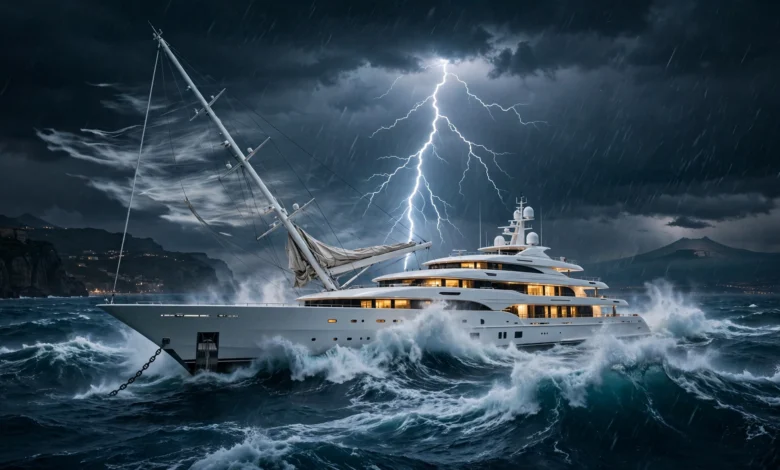
The crew of the superyacht Bayesian had no warning of the danger that sank their vessel off Sicily, Britain’s Marine Accident Investigation Branch has concluded in its final report, published on Thursday 19 November 2026. A sudden downburst of hurricane-force winds knocked the 56-metre yacht onto its side in less than 15 seconds, and it sank 18 minutes later, killing seven of the 22 people on board.
The report, Accident Investigation Report 22/2026, says the yacht had a vulnerability to high winds that nobody had recognised, because it had never been assessed in the conditions in which it was anchored. The findings stand in sharp contrast to the case building in Italy, where prosecutors have reportedly blamed errors by the crew rather than problems with the yacht.
Bayesian Superyacht MAIB Report — Quick Reference Summary
| Item | Detail |
|---|---|
| Report | MAIB Accident Investigation Report 22/2026, published Thursday 19 November 2026 |
| Vessel | Bayesian, 56-metre (184ft) sailing superyacht, UK-registered |
| Location | At anchor 0.5 nautical miles south-east of Porticello, Sicily |
| Date of sinking | 19 August 2024, capsized at 04:06 |
| People on board | 12 guests and 10 crew; 7 died, 15 survived |
| Those who died | Mike Lynch, 59; his daughter Hannah, 18; Jonathan Bloomer, 70, and his wife Judy Bloomer, 71; a lawyer and his wife; the yacht’s chef |
| Wind speed | About 70 knots (80mph / 129km/h), up from 8 knots within minutes |
| Time to capsize | Less than 15 seconds; sank 18 minutes later |
| Likely cause | Downburst of hurricane-force winds, not explicitly forecast |
| Key finding | Wind vulnerability at anchor with sails down and centreboard raised was never assessed |
| Recommendations | Seven, covering vessel design standards, crew training and severe weather warnings |
| Italian case | Captain James Cutfield, chief engineer Tim Parker Eaton and deckhand Matthew Griffith remain under investigation |
Fifteen seconds from upright to overturned
The report reconstructs the final minutes in stark detail. At 03:55 on 19 August 2024, the crew were alerted by sudden, severe winds of up to 30 knots. Eleven minutes later, at 04:06, the Bayesian violently heeled over 90 degrees to starboard, taking less than 15 seconds to do so. Unable to right itself, the yacht flooded and sank in 50 metres of water.
Wind speeds had risen from about 8 knots to around 70 knots within minutes as thunderstorms moved into the area. The forecast had predicted thunderstorms, but it gave a maximum wind speed of only 27 knots and made no mention of the possibility of violent downbursts. The MAIB concluded that the extreme weather was most likely caused by a downburst, a powerful blast of air from a thunderstorm that hits the sea and spreads out with enormous force.
A weakness nobody had tested for
The central finding of the report is that the Bayesian’s vulnerability to being knocked down by strong winds had never been assessed for the conditions in which it was anchored. Its sails were down and its retractable centreboard, a large underwater structure that helps a vessel stay stable, was raised. The stability studies used to approve the yacht’s Stability Information Booklet never tested whether an anchored yacht in that configuration could be knocked over by violent gusts, and the booklet offered only general guidance on preparing for a storm at anchor.
Investigators found that once the yacht passed a 73-degree heel, it could not right itself. A study commissioned for the investigation concluded that the vessel was particularly exposed to extreme wind acting on its widest point, and that a sudden sideways tipping, or knockdown, would have become irreversible once it passed its angle of vanishing stability.
Rob Loder, the MAIB’s chief inspector of marine accidents, said: “Our investigation found that Bayesian had a vulnerability to high winds that was not recognised, because the yacht had never been assessed at anchor with its sails down. The extreme winds that night were also not explicitly forecast, so the crew had no warning of the risk.”
The forecast that missed the storm
The report is blunt about the gaps in the information available to the crew. David Robertson, the lead investigator, said the forecast did not mention the chance of violent winds, crew training had not covered the danger, and published guidance did not cover it either. The MAIB found that the risks, including the yacht’s vulnerability to extreme winds and the possibility of an unrecoverable knockdown, were not addressed in the UK training syllabus or in the guidance available to the crew.
Simon Graves, the MAIB’s principal inspector, told the Press Association: “The crew were reacting to the situation they found themselves in.” The report also found that alcohol consumption had not contributed to the sinking. The MAIB has published an industry safety flyer alongside the report, and its seven recommendations cover vessel design standards, crew training, life rafts and how rare but severe weather is represented in forecasts. It investigated the sinking because the Bayesian was registered in the UK, and it issued an interim report in May 2025.
The findings matter beyond a single yacht. The MAIB’s warning echoes other recent investigations into transport accidents, including the United Airlines Flight 169 inquiry, where investigators also had to reconstruct seconds of chaos from fragmentary evidence. Extreme weather keeps testing the limits of forecasting, as Storm Charles showed in Portugal last week, when red warnings and 140 km/h gusts shut schools and cancelled Web Summit.
Seven lives lost off Porticello
Seven people died when the Bayesian sank: the British tech entrepreneur Mike Lynch, 59, and his 18-year-old daughter Hannah; Morgan Stanley International bank chairman Jonathan Bloomer, 70, and his wife Judy Bloomer, 71; a lawyer and his wife; and the yacht’s chef. Inquest proceedings in the UK are looking at the deaths of Mr Lynch, his daughter and the Bloomers, who were all British nationals.
The sinking was one of the most closely watched maritime disasters of recent years, not least because of who was on board. Lynch had built the software company Autonomy and sold it to Hewlett-Packard, and the voyage came weeks after he was acquitted in a long-running US fraud trial linked to that sale. The human cost, however, is what the report returns to: 15 people survived, seven did not, and the difference came down to a risk that had never been measured.
A report that clashes with Italy’s case
The MAIB’s conclusions appear to differ from the direction of the criminal investigation in Italy, where prosecutors’ expert witnesses have reportedly blamed errors by the crew rather than problems with the yacht. Captain James Cutfield, chief engineer Tim Parker Eaton and deckhand Matthew Griffith remain under investigation over potential charges of multiple manslaughter and culpable shipwreck, and that investigation has not concluded.
The British report itself carries a caveat: it says it is possible that the circumstances it describes may alter following disclosure of evidence withheld by the Italian authorities. The Maritime and Coastguard Agency is also investigating the sinking. For now, though, the official British account places the fault in the yacht’s design and in a risk that was never assessed, not in a single act of seamanship on the night.
Seven recommendations for the superyacht fleet
The report makes seven recommendations, and the MAIB says they are aimed at preventing a repeat rather than apportioning blame. They cover new rules for monohull sailing yachts, improvements to life rafts, better crew training and clearer warnings about rare but severe weather for seafarers. The safety flyer published with the report is aimed directly at the industry, urging operators and crews to understand how vulnerable a large sailing yacht can be when it is at anchor with no sails set.
Whether the industry acts on those recommendations, and whether the Italian courts reach a different conclusion about the crew, will shape the legacy of the Bayesian. What the MAIB has established is that a 56-metre yacht, anchored in a forecast thunderstorm, could be knocked flat in under 15 seconds by winds nobody had warned its crew about, because nobody had ever checked whether it could happen. The full findings are set out in the MAIB’s final report, and Reuters coverage of the report confirms the same central conclusion.
Frequently asked questions
Q: What did the MAIB report into the Bayesian sinking conclude?
A: It found the 56-metre superyacht had an unrecognised vulnerability to high winds when anchored with its sails down and its centreboard raised, and that the crew had no warning because the extreme winds were not explicitly forecast.
Q: How fast did the Bayesian capsize?
A: The yacht was knocked onto its side in less than 15 seconds after being hit by winds of about 70 knots (80mph), and it sank 18 minutes later.
Q: Who died when the Bayesian sank?
A: Seven people: Mike Lynch, 59, his daughter Hannah, 18, Jonathan Bloomer, 70, and his wife Judy Bloomer, 71, a lawyer and his wife, and the yacht’s chef. Fifteen of the 22 people on board survived.
Q: When did the Bayesian sink?
A: In the early hours of 19 August 2024, at 04:06, while anchored 0.5 nautical miles south-east of Porticello, Sicily. The MAIB’s final report was published on Thursday 19 November 2026.
Q: Does the report blame the crew?
A: No. It says the crew were reacting to a situation they had not been warned about, and that the risk had never been assessed or covered in training or guidance. The Italian criminal investigation into three crew members continues separately.