

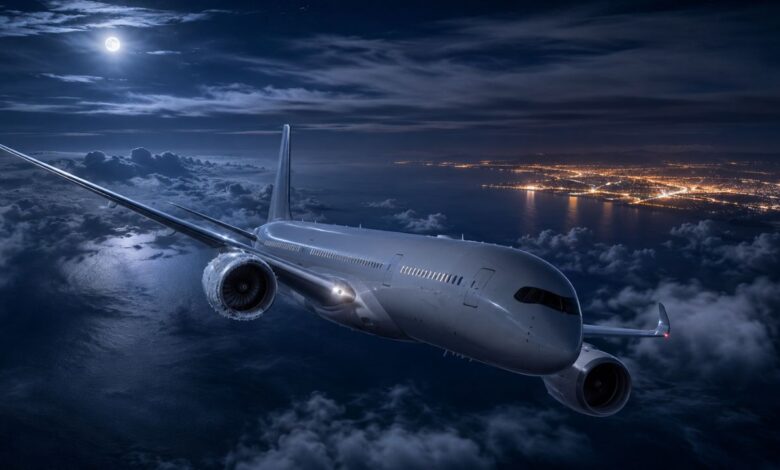
The aircraft was already deep into its trans-Pacific journey when the crew abandoned Tokyo and began a five-and-a-half-hour diversion toward Los Angeles.
Delta Flight DL275 was supposed to connect Detroit with Tokyo Haneda. Instead, the Airbus A350 crossed northern Pacific airspace, reversed course over the Bering Sea and landed at Los Angeles International Airport after an unusually long diversion.
The event has since been repeatedly republished as a recent or breaking emergency. The underlying incident, however, occurred on May 26–27, 2025—not in 2026. Aviation incident records identify an apparent engine anti-ice system problem, while contemporaneous tracking reports confirm that the aircraft landed safely on LAX Runway 06R.
The central question is not simply why DL275 diverted. It is why the pilots selected Los Angeles when other airports appeared geographically closer.
Delta Flight DL275 diverted to LAX after the crew reportedly identified a problem involving an engine anti-ice system while cruising over the Bering Sea. The Airbus A350-900, registration N508DN, landed safely at Los Angeles approximately five and a half hours after changing course. The Tokyo sector was subsequently cancelled.
DL275 Diversion: Verified Flight Details
| Detail | Verified information |
|---|---|
| Airline | Delta Air Lines |
| Flight number | DL275 |
| Original route | Detroit Metropolitan Wayne County Airport to Tokyo Haneda Airport |
| Incident date | May 26, 2025 |
| Landing date | Early May 27, 2025, local Los Angeles time |
| Aircraft | Airbus A350-900, formally registered as an A350-941 |
| Registration | N508DN |
| Engine type | Rolls-Royce Trent XWB-84 |
| Reported cruise altitude | Flight Level 380, approximately 38,000 feet |
| Approximate decision point | About 620 nautical miles west-southwest of Anchorage |
| Diversion airport | Los Angeles International Airport |
| Landing runway | Runway 06R |
| Reported technical concern | Engine anti-ice system problem |
| Immediate outcome | Safe landing; no injuries reported in the reviewed sources |
| Passenger recovery | Remaining journey cancelled and passengers rebooked |
| Aircraft downtime | Approximately 18.5 hours before returning to service |
The FAA registry confirms that N508DN is a 2018 Airbus A350-941 registered to Delta Air Lines and powered by Rolls-Royce Trent XWB-84 engines. The aircraft’s official registration remained valid when the registry was checked.
The Night DL275 Abandoned Its Tokyo Crossing
Delta Flight DL275 departed Detroit for a scheduled long-haul service to Tokyo Haneda on May 26, 2025. The route normally takes the aircraft northwest across Canada and Alaska before entering northern Pacific airspace.
At Flight Level 380 over the Bering Sea region, the crew elected not to continue toward Japan. The Aviation Herald’s incident record, reproduced by AeroInside, places the aircraft approximately 620 nautical miles west-southwest of Anchorage when the diversion began.
Contemporaneous tracking coverage showed N508DN turning toward the continental United States. Instead of landing in Alaska, the aircraft continued south along the Pacific side of North America.
The Airbus reached Los Angeles at approximately 1:38 a.m. local time and landed on Runway 06R. AIRLIVE published its initial tracking report within minutes of the arrival, at 08:44 UTC on May 27. This timing supports an occurrence date of May 26 and an early-morning LAX landing on May 27—not the May 28 date reproduced by several later articles.
Reconstructed sequence
- May 26, 2025: DL275 departs Detroit for Tokyo Haneda.
- Several hours after departure: The Airbus A350 reaches the Bering Sea sector at approximately 38,000 feet.
- Around 620 nautical miles west-southwest of Anchorage: The crew decides to divert.
- Approximately 5.5 hours later: N508DN lands safely on LAX Runway 06R.
- After arrival: Delta cancels the remainder of the Tokyo journey and rebooks affected passengers.
- Approximately 18.5 hours after landing: The aircraft returns to operational service, according to the specialist incident record.
What the Engine Anti-Ice Warning Actually Meant
Passenger accounts cited by aviation incident reporting indicated that the crew announced a problem involving the Rolls-Royce Trent XWB engine anti-ice system. This is the strongest documented explanation for the diversion, but it requires an important qualification: no detailed Delta engineering report or public regulatory finding has been located that identifies the exact failed component.
Engine anti-ice equipment protects exposed inlet and internal components against ice accumulation. Ice can form when an aircraft travels through visible moisture at sufficiently low temperatures. Accumulation around an engine intake can disturb airflow, reduce performance or release ice fragments into downstream components.
Rolls-Royce documentation describes heated passages within engine components that form part of the anti-icing protection used during adverse weather. The manufacturer also conducts dedicated cold-weather and icing tests on its civil aerospace engines.
A fault indication does not automatically mean that the engine stopped producing thrust. The available incident records do not report an in-flight engine shutdown, flameout, fire or loss of thrust. They describe an anti-ice system problem associated with an otherwise operating Trent XWB engine.
That distinction matters. An engine failure would normally create a more urgent landing requirement. An anti-ice fault can instead make continued flight through forecast icing conditions operationally unacceptable, even when the engine remains stable.
The diversion should be understood as a controlled risk-management decision, not evidence that the aircraft was falling out of the sky. The crew moved away from a remote oceanic route before a manageable system fault could become a more serious exposure.
Why Did the Pilots Choose LAX Instead of Anchorage?
No public Delta statement reviewed for this article explains the airport-selection calculation. Any claim that Los Angeles was chosen for one specific reason should therefore be treated as an inference rather than a confirmed fact.
Several operational considerations nevertheless make LAX a plausible destination:
Maintenance capability
Los Angeles is a major Delta station that routinely handles Airbus A350 international operations. A large airline station generally provides better access to qualified technicians, replacement components, engineering support and passenger-recovery resources than a smaller diversion airport.
Weather and icing exposure
If the problem affected anti-ice protection, routing toward warmer conditions may have reduced the probability of encountering additional icing. The precise weather data and dispatch analysis used by DL275’s crew have not been publicly released.
Runway and aircraft-handling requirements
A long-haul A350 can arrive with substantial fuel and landing weight. Airport suitability involves runway length, weather, braking conditions, approach capability, rescue services, parking space and ground equipment—not simply distance on a map.
Passenger recovery
LAX offers extensive trans-Pacific connectivity, Delta operations and access to partner flights. Those resources can make it easier to rebook hundreds of international passengers than at an airport with limited Japan-bound service.
Nature of the malfunction
FAA regulations require a two-engine airliner with an engine failure or precautionary engine shutdown to land at the nearest suitable airport in point of time. Public reporting does not indicate that either DL275 engine failed or was shut down, so that specific regulatory trigger cannot be assumed to have applied.
Extended-range operations are planned around adequate diversion airports, aircraft system endurance, weather and route-specific contingencies. FAA guidance requires operators to evaluate diversion airports and equal-time points before operating over remote oceanic regions.
The relevant concept is therefore the safest suitable airport, not necessarily the closest visible runway.
The Aircraft at the Centre of the Diversion
N508DN is an Airbus A350-941 manufactured in 2018. According to the FAA Aircraft Registry, Delta Air Lines is its registered owner and the aircraft uses two Rolls-Royce Trent XWB-84 turbofan engines.
The Airbus A350-900 is designed specifically for long-range, twin-engine operations. Airbus lists a maximum range of approximately 9,700 nautical miles for current configurations, although an airline’s practical range varies with payload, weather, routing and operating configuration.
| Aircraft characteristic | N508DN or A350-900 data |
|---|---|
| Manufacturer | Airbus |
| Registered model | A350-941 |
| Aircraft category | Fixed-wing, multi-engine transport aircraft |
| Manufacturing year | 2018 |
| Engine manufacturer | Rolls-Royce |
| Engine model | Trent XWB-84 |
| Typical A350-900 seating | Approximately 300–352 passengers, depending on configuration |
| Maximum published A350-900 range | Up to approximately 9,700 nautical miles in the latest Airbus specification |
| Primary operational role | Long-haul and ultra-long-haul passenger transport |
The diversion did not produce evidence of permanent aircraft damage. The incident database states that N508DN remained at LAX for approximately 18.5 hours before returning to service. That interval would have allowed engineering inspection, troubleshooting, repair, testing and operational release, although the exact maintenance work has not been disclosed.
What Is Confirmed—and What Remains Unverified
The online coverage surrounding “Delta flight DL275 diverted LAX” contains several contradictions. Some reports shifted the event forward by one or two days, while later low-authority articles described it as if it had just happened.
Confirmed by consistent aviation records
- DL275 was operating from Detroit to Tokyo Haneda.
- The aircraft was Airbus A350-900 N508DN.
- The diversion began over the Bering Sea region.
- The aircraft was cruising at approximately Flight Level 380.
- The diversion decision was made roughly 620 nautical miles west-southwest of Anchorage.
- The aircraft landed safely at LAX on Runway 06R.
- The continuation to Tokyo was cancelled.
- Passengers were rebooked.
- The aircraft later returned to service.
Supported but not independently detailed by Delta
- Passengers reportedly heard an announcement identifying an engine anti-ice system problem.
- The fault reportedly involved the Trent XWB anti-ice system.
- The diversion from the decision point lasted approximately five to five and a half hours.
Not established by the reviewed evidence
- A complete engine failure.
- An in-flight engine shutdown.
- A fire or smoke event.
- A medical emergency.
- Structural damage.
- The exact cockpit warning or maintenance fault code.
- The precise reason LAX was selected over every alternative airport.
- A verified passenger and crew count.
- A public FAA or NTSB investigative finding assigning a formal cause.
Calling the event a “crash,” “near crash” or confirmed engine failure would therefore be inaccurate.
The Diversion’s Real Safety Lesson
DL275 demonstrates how long-haul risk decisions can look counterintuitive from the ground. Flight-tracking users saw an aircraft turn away from Tokyo, bypass apparent alternatives and remain airborne for hours. That visual pattern created the impression of an extreme emergency.
The operational evidence points in the opposite direction.
The aircraft remained controllable, continued at long-range cruise capability and reached a major maintenance station without a reported injury. The crew did not continue deeper across the Pacific with a potentially degraded ice-protection function. They repositioned the aircraft toward an airport capable of supporting the jet, its passengers and the subsequent technical inspection.
A lengthy diversion is not automatically a dangerous diversion. In some system-fault scenarios, the ability to select and reach a strategically suitable airport is evidence that the situation remained stable enough for deliberate decision-making.
Frequently Asked Questions
Why was Delta Flight DL275 diverted to LAX?
Delta Flight DL275 was diverted after the crew reportedly identified a problem with an engine anti-ice system while flying over the Bering Sea. The aircraft did not continue to Tokyo because the system fault could have created unacceptable exposure during the remaining trans-Pacific flight. Delta has not publicly released a detailed technical diagnosis.
When did the DL275 diversion happen?
The incident occurred on May 26, 2025, with the aircraft landing at Los Angeles early on May 27, 2025, local time. Some later articles incorrectly describe the event as occurring on May 28 or present it as recent breaking news. Contemporaneous UTC publication and landing information support the May 26–27 timeline.
Did an engine fail on Delta Flight DL275?
There is no verified evidence that an engine failed or was shut down. Specialist reporting identifies an engine anti-ice system problem based on information communicated to passengers. An anti-ice fault affects protective equipment but does not necessarily prevent the engine from continuing to produce normal thrust.
Was anyone injured when DL275 landed at LAX?
No injuries were reported in the aviation sources reviewed. The Airbus A350 landed safely on LAX Runway 06R, and the passengers were subsequently rebooked after the remaining Tokyo sector was cancelled. The available record describes an operational incident rather than an accident.
Why did DL275 fly to Los Angeles instead of landing in Alaska?
Delta has not publicly confirmed the airport-selection rationale. LAX may have offered a more suitable combination of weather, maintenance facilities, runway capability, aircraft support and passenger rebooking options. Because no engine failure or shutdown was reported, the crew may have had sufficient operational flexibility to select a distant but better-equipped airport.
What happened to aircraft N508DN after the diversion?
N508DN remained on the ground at Los Angeles for approximately 18.5 hours before returning to service, according to the incident record. The exact inspection findings, replaced components and maintenance actions were not publicly disclosed. Its relatively prompt return indicates that the aircraft was repaired or cleared following technical evaluation.
A Controlled Turn Away From Greater Risk
The most significant fact about Delta Flight DL275 is not that it travelled thousands of miles away from its scheduled destination. It is that the crew identified a system concern while approaching remote oceanic airspace and chose not to compound the exposure.
N508DN reached Los Angeles safely. The passengers’ journey was disrupted, the Tokyo continuation was cancelled and the aircraft underwent hours of technical attention. Yet the evidence does not support sensational descriptions of catastrophic engine failure or imminent disaster.
DL275 was a precautionary long-range diversion triggered by a reported anti-ice system problem. The five-and-a-half-hour route to LAX may have appeared extraordinary on a flight-tracking map, but it remained consistent with the central logic of commercial aviation safety: preserve options, avoid worsening conditions and place the aircraft where the problem can be properly managed.
Sources and Verification
- Federal Aviation Administration aircraft registration record for N508DN, confirming manufacturer, model, owner, manufacturing year and engine type. (FAA Registry)
- Airbus official A350-900 technical and performance information. (Airbus Aircraft)
- FAA guidance covering extended operations, remote-airspace diversion planning and suitable alternate airports. (Federal Aviation Administration)
- Electronic Code of Federal Regulations, 14 CFR §121.565, covering landing requirements following an engine failure or shutdown. (eCFR)
- The Aviation Herald incident entry for Delta DL275, accessed through its indexed record and licensed AeroInside reproduction. (AvHerald)
- AIRLIVE’s contemporaneous flight-tracking report, published immediately after the LAX arrival. (AIRLIVE)
- Rolls-Royce technical material concerning Trent engine anti-icing components and cold-weather testing. (Rolls-Royce)
- No detailed public statement from Delta or final FAA/NTSB causal report was located for the specific technical malfunction.
Author Box
- Author: Alastair Thorne
- Title: Global Current Affairs & Political Editor
- Bio: Alastair Thorne is a global current affairs editor with a focus on trans-Atlantic political shifts and macroeconomic policies. His investigative reporting provides readers with unbiased, high-stakes context on breaking international news.
Editorial Disclaimer: This report distinguishes confirmed registration and flight information from passenger-reported technical details and editorial analysis. Where Delta Air Lines, the FAA or another competent authority has not published a definitive technical finding, the limitation is stated explicitly. Flight times and positions may vary slightly between tracking providers.