
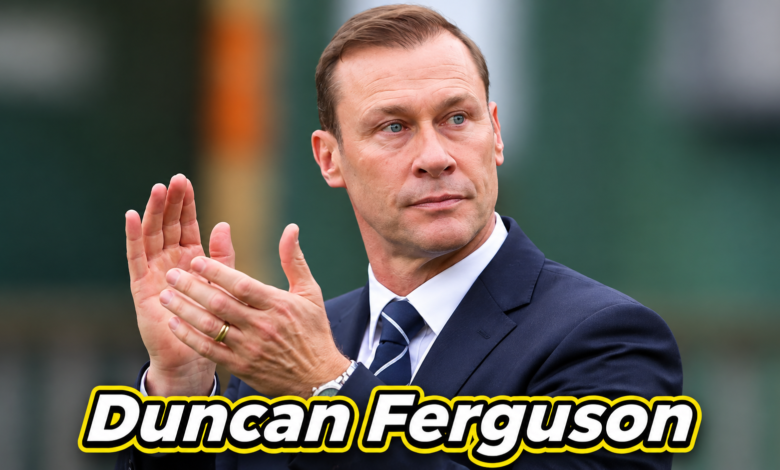
Duncan Ferguson is a former Scotland international striker whose name still carries weight at Goodison Park more than two decades after his playing peak. Born in Stirling on 27 December 1971, the 6 ft 4 in forward — known to Everton supporters simply as “Big Dunc” — built a reputation as one of British football’s most fearsome centre-forwards. As of late November 2026, the 54-year-old has begun a new chapter as head coach of Northern Irish club Glentoran.
Ferguson’s story runs from a British-record transfer to Rangers in 1993, through two spells at Everton and a spell at Newcastle United, to FA Cup glory, red cards, a prison sentence, bankruptcy and a long road back through coaching. This profile sets out the verified facts of his age, career, family and finances — and separates them from the guesswork that surrounds his net worth.
Duncan Ferguson — Quick Reference Profile
| Full name | Duncan Cowan Ferguson |
| Known as | Big Dunc; Duncan Ferguson |
| Date of birth | 27 December 1971 |
| Age | 54 (as of 29 November 2026; turns 55 on 27 December 2026) |
| Birthplace | Stirling, Scotland |
| Nationality | Scottish |
| Ethnicity | Not publicly verified |
| Primary role | Former professional footballer (striker); football manager |
| Associated entities | Everton FC; Scotland national football team; Dundee United; Rangers; Newcastle United; Glentoran |
| Estimated net worth (2026) | Not publicly verified — no reliable figure exists |
| Height | 6 ft 4 in (1.93 m) |
| Spouse | Janine Ferguson |
| Children | Three, including son Cameron, a professional footballer |
| Social media | No verified public handles found |
From Stirling to Tannadice: Formative Years and Family Roots
Ferguson was born in Stirling, Scotland, on 27 December 1971. Little reliable public information exists about his parents, schooling or childhood, and this profile does not fill those gaps with guesswork. What the record does show is a teenager who broke into senior football early and never looked back.
He began his senior career at Dundee United, the club where he first caught the eye of bigger sides. His size, strength and appetite for the physical side of the game marked him out at once. By 1992 he had won a Scotland cap and a place in the squad for UEFA Euro 1992, before his 21st birthday.
Big Dunc at His Peak: The Career That Made an Everton Legend
Ferguson’s playing career took him from Tannadice to Ibrox, Goodison Park and St James’ Park, and his statistics tell only part of the story. The full picture, including his international record and managerial career, is set out in his Wikipedia profile. Across his league career he made 360 appearances and scored 98 goals.
Dundee United and the British-record move to Rangers
Ferguson made his senior debut for Dundee United in 1990 and scored 28 goals in 77 league appearances for the club. He also reached the Scottish Cup final with United in 1991. In July 1993, Rangers paid £4 million for him, a British transfer record at the time.
His stay at Ibrox was short, with 14 league appearances and two goals, but he still collected a Scottish Premier Division winner’s medal in the 1993–94 season. Within a year he was on his way to Merseyside, where his name would be made.
First spell at Everton and the 1995 FA Cup
Everton first signed Ferguson on loan in October 1994, then permanently. He scored 35 goals in 107 league appearances in that first spell, and his finest hour came in May 1995, when Everton beat Manchester United 1–0 to win the FA Cup. He was named Premier League Player of the Month for February 1995.
The same spell also built his reputation for trouble. Ferguson collected nine red cards in his career, eight of them in the Premier League, a total that leaves him joint-top of the Premier League’s all-time dismissals list alongside Patrick Vieira and Richard Dunne.
Newcastle United and the return to Goodison
In November 1998, Newcastle United paid £8 million for Ferguson. Injuries limited him to 30 league appearances and eight goals on Tyneside, although he reached another FA Cup final in 1999, finishing as a runner-up. Like Ferguson, former England international Karen Carney built a long career at the top of the game; our Karen Carney profile sets out her age, career and net worth in the same format.
Everton brought him back in August 2000 for £3.75 million. He scored 23 goals in 123 league appearances in his second spell and retired in May 2006, still a hero to the Goodison crowd. Across his two spells he scored 58 league goals for the club.
Scotland career and the move into management
Ferguson won seven caps for Scotland between 1992 and 1997, without scoring, and was part of the Euro 1992 squad. His last cap came against Estonia in February 1997, after which he made himself unavailable for international selection.
After retiring he joined Everton’s coaching staff in 2011 and later took charge as caretaker manager twice: in December 2019, when his first match ended in a 3–1 win over Chelsea, and in January 2022. He then managed Forest Green Rovers from January to July 2023, a spell that ended in relegation, and Inverness Caledonian Thistle from September 2023 until October 2024, when he was dismissed after the club entered administration, having worked without pay.
On 19 October 2026, Ferguson was appointed head coach of Glentoran in Northern Ireland, his latest step on the touchline. His autobiography, Big Dunc, was published in May 2025 and became a Sunday Times bestseller.
| Club | Years | League appearances | League goals |
|---|---|---|---|
| Dundee United | 1990–1993 | 77 | 28 |
| Rangers | 1993–1994 | 14 | 2 |
| Everton | 1994–1998 | 107 | 35 |
| Newcastle United | 1998–2000 | 30 | 8 |
| Everton | 2000–2006 | 123 | 23 |
| Career total | 360 | 98 |
Money, Tax Schemes and Bankruptcy: The Truth About His Net Worth
No reliable public figure exists for Duncan Ferguson’s net worth in 2026, and this profile does not invent one. His finances are private, and no credible outlet has published a verified valuation. What can be documented is the shape of his earnings and his losses, and Six Magazine’s profile of Ferguson reaches the same conclusion: the figure is not disclosed.
At his peak he earned elite wages for the era. Contemporary reporting put his Everton pay in the late 1990s at around £30,000 a week, roughly £1.5 million a year. Rangers paid a British-record £4 million for him in 1993, although transfer fees go to the selling club rather than the player. Other biographies on this site face the same problem: our Francis Bourgeois profile also records a net worth as not publicly verified, because no reliable figure exists.
The losses are a matter of public record. Ferguson has spoken about failed land developments and film tax schemes that wiped out millions of pounds. In January 2016, reports confirmed that he had been declared bankrupt by the High Court. Bankruptcy is a reset, not a life sentence, and Ferguson rebuilt his working life through coaching, media work and his book.
Since retiring, his income has come from coaching salaries, media appearances and royalties from Big Dunc. Those are steady professional earnings, not the wealth of a modern Premier League star. Any website that states an exact net worth figure for Ferguson is guessing, and readers should treat such numbers with scepticism.
Life Away From the Pitch: Family, Style and Lasting Impact
Ferguson is married to Janine Ferguson, and the couple have three children. His son Cameron is a professional footballer who has played in Wales for Connah’s Quay Nomads. Ferguson keeps his family life largely private, and little else about his home life is a matter of public record.
On the pitch, his style was unmistakable: a towering target man who relished physical battles, won headers and scored headed goals. His career also carried controversy, including a 1995 prison sentence following an on-field assault during his time in Scotland. Off the field he became a folk hero at Everton, where supporters still sing his name.
His standing at the club was clear when he returned as caretaker manager in 2019, and his autobiography became a Sunday Times bestseller in 2025. In October 2026 he took his first senior head-coach role in Northern Ireland with Glentoran, a new test for a man whose playing reputation was built on confrontation.
Duncan Ferguson FAQs: Age, Wife, Net Worth and More
How old is Duncan Ferguson? He was born on 27 December 1971, so he is 54 as of 29 November 2026. He turns 55 on 27 December 2026.
Who is Duncan Ferguson’s wife? Ferguson is married to Janine Ferguson. The couple have three children, and their son Cameron is a professional footballer.
What is Duncan Ferguson’s net worth? No reliable figure exists. His net worth is not publicly verified. He earned millions at his peak, lost millions through failed investments, and was declared bankrupt in 2016.
Which clubs did Duncan Ferguson play for? Dundee United, Rangers, Everton in two spells, and Newcastle United. He made 360 league appearances and scored 98 league goals, and won seven caps for Scotland.
What is Duncan Ferguson doing now? He has been head coach of Glentoran since 19 October 2026. Before that he was caretaker manager of Everton twice, and manager of Forest Green Rovers and Inverness Caledonian Thistle.
One claim is worth correcting. Ferguson is sometimes described as a millionaire footballer living off his playing fortune. The documented record says otherwise: his peak earnings were real, but so were the losses, and no verified net worth figure exists. He is also not related to Sir Alex Ferguson; the two men simply share a surname.