

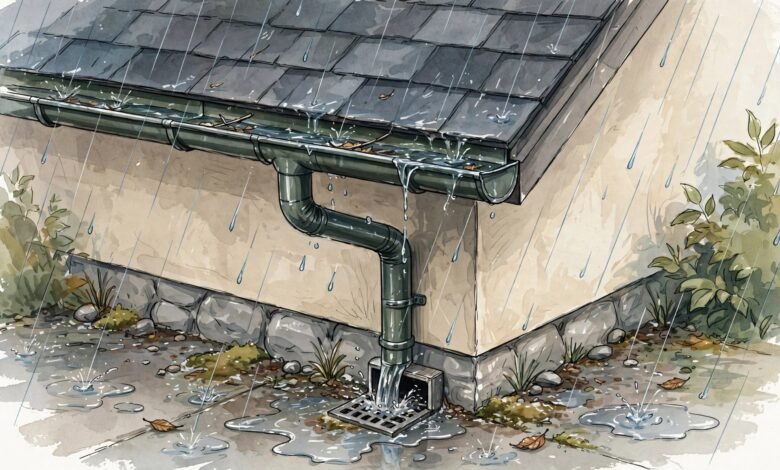
A Czech plumbing word is suddenly appearing in English-language search — and some of the posts using it are not talking about plumbing at all. Gajgry is the Czech plural of gajgr, a roof drain trap fitted at the base of a rainwater downpipe, and the newer skincare meaning attached to it is a coined term with no recognition in cosmetic science. The plumbing meaning is the real one; the rest is noise worth clearing up before anyone spends money on it.
| Word | Gajgry (plural); singular gajgr |
| Language | Czech |
| Czech technical name | Lapač střešních splavenin — a trap for matter washed off a roof |
| English equivalents | Roof drain trap, downpipe gully, roof debris trap |
| Where it sits | At the base of a rainwater downpipe, where it meets the drain |
| What it does | Lets rainwater through while catching leaves, twigs, moss and grit |
| What it is not | Not a skincare product, not a phone app, not an online service |
Why a drain fitting is suddenly being searched
The word has travelled the usual path for an obscure term: a few English-language explainers picked it up, search interest followed, and then a second, unrelated meaning attached itself. A gajgry drainage guide describes the fitting plainly — a trap below the gutter downpipe that guides rainwater into drain pipes — and several guides published in the last few weeks say the same thing in the same words.
The confusion comes from the newer posts. Some 2026 online writing uses “gajgry” for “sunscreen traps”, as if it were a skincare concept. There is no cosmetic-science source that recognises that usage, and no verified skincare product by the name. It reads as a coined term — a plumbing word borrowed because it sounds technical — rather than a real category. Anyone buying a product on the strength of that meaning would be buying a word, not a tested formula.
How a gajgr actually works
The job is simple and it has not changed in a long time. Rain washes leaves, twigs, moss and grit off a roof and down the gutter. At the bottom of the downpipe, the gajgr catches that debris in a basket or chamber while the water passes through into the buried drain. Without it, the debris goes straight into the underground pipe, where it is far harder to clear.
The idea is old enough to sit in a museum. The Science Museum’s gutter trap, a stoneware fitting from England dated 1850–1865, did the same job: stopping debris such as leaves and rubbish from clogging drains. Blocked drains were treated as a public nuisance then, and they still cause the same trouble now — standing water, smells and, in heavy rain, water finding its way into places it should not go.
Sellers list several types of gajgr, sized to the downpipe they serve and made for different roof and drainage setups. The details vary by manufacturer, so the right check before buying is the downpipe size and whether the trap can be opened and cleaned easily — a trap that cannot be emptied is just a future blockage with a lid on it.
What to check before buying or fitting one
First, match the fitting to the downpipe: the wrong size will either leak around the joint or throttle the flow in heavy rain. Second, make sure the debris basket or grate can be lifted out and cleaned without tools you do not own — a trap is only useful if someone actually empties it. Third, check what your local building practice expects for rainwater drainage, because rules on where roof water may go differ by place.
Heavy rain is the real test of any drainage fitting, and the Florida flooding in November 2026 showed what happens when more than a foot of rain falls in a day: drains, gutters and ground-level outlets all working at once, with nowhere for the water to wait. A single trap will not save a house from a flood, but a clear one is the difference between rainwater leaving the roof cleanly and debris building up exactly when the system is under the most strain.
And if the product in front of you is a cream, a serum or a “sunscreen trap” with gajgry on the label, check for the things a real cosmetic product has — an ingredients list, a manufacturer, a safety assessment — before assuming the plumbing word means anything in a bathroom. On the evidence available, it does not.
| Claimed meaning | What the evidence says |
|---|---|
| Roof drain trap (Czech gajgr) | Verified — a real building trade item, sold by drainage firms under that name |
| Skincare “sunscreen traps” | Not verified — a coined 2026 online usage, not recognised in cosmetic science |
| Phone app or online service | Not verified — no such product; the term belongs to building work |
Frequently Asked Questions
Q: Is gajgry a skincare product? A: No. Gajgry is a Czech plumbing term for roof drain traps. The skincare usage appearing in some 2026 posts is coined and unverified, with no recognised cosmetic product behind it.
Q: What is the singular of gajgry? A: Gajgr. Gajgry is the plural form.
Q: What does lapač střešních splavenin mean? A: It is the Czech technical name for the fitting, and it means a trap for matter washed off a roof — which is exactly what the part does.