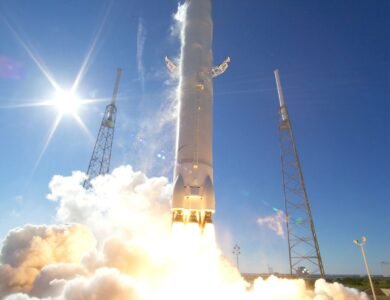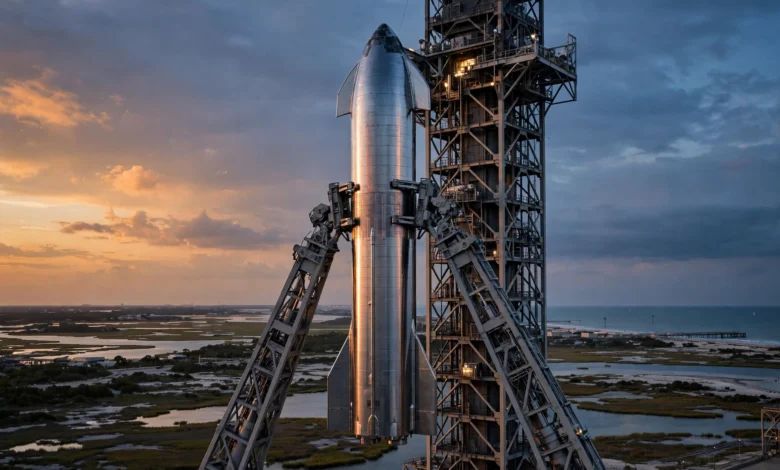
SpaceX made history on Saturday 14 November 2026 when the SpaceX Starship Flight 15 catch saw the giant Starship spacecraft return from orbit and settle into the mechanical arms of its launch tower at Starbase, Texas. The uncrewed ship had spent about 22 hours circling Earth after launching the day before, and its upright capture marked the first time any orbital upper stage has come home to its launch site in this way. The mission was not a clean sweep, though: the Super Heavy booster meant to be caught alongside it aborted its own return and was destroyed over the Gulf of Mexico.
| Detail | SpaceX Starship Flight 15 |
|---|---|
| Mission | 15th Starship test flight; first planned double catch of both stages |
| Launch | Friday 13 November 2026, 5:47 pm EST, Pad 2, Starbase, Texas |
| Vehicle | Starship V3 — Super Heavy Booster 22 and Ship 42; 124 metres tall |
| Ship result | Caught by the Mechazilla tower arms on Saturday 14 November at about 4:20 pm EST |
| Booster result | Catch aborted; diverted to the Gulf of Mexico and destroyed |
| Satellites deployed | 26 Starlink V3 satellites |
| Time in orbit | About 22.5 hours, around 14 orbits |
| Next flight | Flight 16 could launch from Kennedy Space Center, Florida |
How the Ship’s 22-Hour Round Trip Unfolded
Starship lifted off from Starbase on Friday afternoon under the power of the Super Heavy booster’s 33 Raptor engines. After hot-staging separation, the ship fired its six Raptor engines and reached orbit roughly 26 minutes after launch, then released 26 Starlink V3 satellites into orbit. It was the first flight of the newer V3 design, and SpaceX had planned to recover both stages at the tower for the first time.
The ship then settled into a long orbital coast of about 22.5 hours and around 14 orbits around Earth. SpaceX reported during the flight that the ship and its heat shield were healthy, with no issues being tracked on the vehicle or the range for its return. A planned 10-second deorbit burn on a single Raptor engine then started the descent through the atmosphere towards Starbase.
Emerging from the clouds, the ship fired three Raptor engines to execute its landing flip and slow its descent, then slid into the waiting chopstick arms of the Mechazilla tower. The catch completed a full round trip from launch to orbit and back to the same launch pad, a feat no rocket has achieved before. Google chief executive Sundar Pichai was among those hailing the moment, describing it as an event that still feels like science fiction.
Why the Super Heavy Booster Missed Its Catch
The booster’s part of the plan unravelled minutes after liftoff. It performed its directional flip after separation and reignited 32 of its planned 33 Raptor engines for the boostback burn, but the burn ended earlier than planned because of low fuel mass, according to SpaceX. Its guidance, navigation and control system then detected that it was not in the correct position for a catch and called the attempt off.
Controllers diverted the booster away from the tower towards the Gulf of Mexico, where it performed a landing burn before its flight termination system was activated and it was destroyed. SpaceX spokeswoman Kate Tice said the booster’s engines shut down too early during its return, and the company is still investigating the root cause, as reported by Dawn. It was a setback with a clear precedent behind it: SpaceX had already caught the booster three times on earlier flights, but those used the older version, and this was the first attempt to catch a V3 booster.
What the Catch Changes for Reusable Rockets
For a decade, SpaceX has landed the first-stage boosters of its smaller Falcon 9 rockets and flown them again, but the upper stages of those rockets are still thrown away after every flight. Catching the Starship upper stage closes that gap and moves the company closer to a fully reusable rocket, which it presents as the route to cheaper and more frequent spaceflight. The Deccan Herald report on the flight underlined that the successful catch was the first of its kind for a spacecraft returning from orbit.
The result also matters for the pace of Starlink deployment. Flight 15 carried 26 of the larger V3 Starlink satellites into orbit, and a reusable Starship that can fly, return and be caught in a single day would let SpaceX put far more of them up per launch than Falcon 9 can manage. The same reusable design sits at the centre of the company’s longer-term plans, and the technology on show in Texas this weekend was the same kind of rapid-turnaround hardware the industry has been watching, much as the record demand behind GTA VI pre-orders has shown how quickly a single launch event can dominate the technology conversation.
What Happens Next for Starship
With Flight 15 over, attention turns to Flight 16, which could be the first Starship launch from SpaceX’s revamped launchpad at the Kennedy Space Center in Florida. That would give the programme a second launch site and room for a faster flight rate. Before then, engineers must pin down why the V3 booster’s boostback burn ended early, since the double catch remains unachieved and the first-stage recovery is half of the reusability equation.
The ship’s catch alone, however, has already reset expectations for what a returning spacecraft can do. An orbital vehicle that can fly for almost a full day, re-enter, flip itself upright and be plucked from the air by its own launch tower is no longer a rendering or a plan. It happened on Saturday afternoon in South Texas, and the footage of the ship hanging in the tower’s arms is now the image the rest of the programme will be measured against.
SpaceX Starship Flight 15: Your Questions Answered
When did SpaceX catch Starship on Flight 15?
The SpaceX Starship Flight 15 catch took place at about 4:20 pm EST on Saturday 14 November 2026, roughly 22.5 hours after the rocket launched from Starbase, Texas, on Friday 13 November.
Did the Super Heavy booster survive Flight 15?
No. The booster aborted its catch attempt after its boostback burn ended early, diverted over the Gulf of Mexico and was destroyed when its flight termination system activated. SpaceX is investigating the cause.
How many satellites did Flight 15 deploy?
The ship deployed 26 Starlink V3 satellites into orbit shortly after reaching orbit on Friday 13 November 2026.
Was Flight 15 a complete success?
Not entirely. The ship’s tower catch after orbit was a historic first, but the planned double catch failed when the Super Heavy booster was lost, so the mission ended as a partial success.
What is Mechazilla?
Mechazilla is the nickname for SpaceX’s launch tower at Starbase, whose two giant mechanical arms, known as chopsticks, catch returning vehicles in mid-air.