
Stronger Cholesterol Treatment Shrinks Plaque in Heart Arteries, New Trial Finds

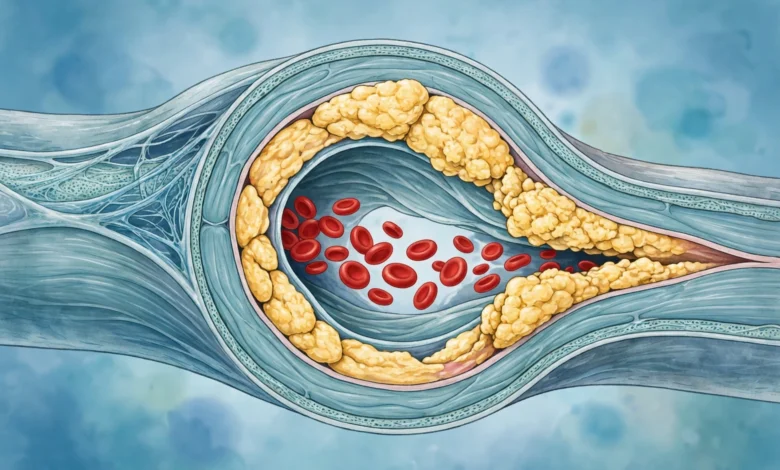
A stronger cholesterol treatment shrinks plaque in heart arteries by 21% in a new trial, researchers reported on 5 November 2026. The FLOWPROMOTE trial, published in JAMA Cardiology, tested whether pushing LDL cholesterol far lower than standard treatment could partly reverse the fatty deposits that narrow the heart’s arteries.
The Danish trial followed 104 adults with stable chest pain and significant coronary artery disease for 18 months. None had taken statins before. Half received atorvastatin 40 mg a day, a standard high-dose statin, while the other half received a stronger combination of rosuvastatin 40 mg plus ezetimibe 10 mg a day, a drug that blocks cholesterol absorption in the gut.
The combination group saw their LDL cholesterol — often called “bad” cholesterol — fall by 65%, from an average of 127.4 mg/dL to 42.5 mg/dL. The standard group saw a 38% fall. The deeper drop was matched by greater shrinkage of the plaque lining the arteries.
FLOWPROMOTE trial — quick reference summary
| Detail | What the trial found |
|---|---|
| Trial name | FLOWPROMOTE |
| Published | 5 November 2026, JAMA Cardiology |
| Participants | 104 statin-naive adults in Denmark with stable chest pain and more than 50% artery narrowing |
| Duration | 18 months, with CT scans at the start, 9 months and 18 months |
| Standard treatment | Atorvastatin 40 mg daily |
| Stronger treatment | Rosuvastatin 40 mg plus ezetimibe 10 mg daily |
| LDL cholesterol fall | 65% (127.4 to 42.5 mg/dL) with combination therapy, versus 38% with standard treatment |
| Total plaque volume change | Down 21.1% with combination therapy, versus down 13.6% with standard treatment |
| Patients whose plaque shrank | 90% on combination therapy, versus 75% on standard treatment |
| Noncalcified plaque change | Down 28.2% versus down 20.0% |
| Key limit | The trial measured plaque, not heart attacks or strokes |
What the FLOWPROMOTE trial tested — and who took part
The researchers set out to answer a question that earlier studies had left open. Imaging studies had already shown that cholesterol-lowering drugs can shrink plaque, but only by about 1% to 5%. The team wanted to know whether that modest shrinkage was the limit of what medicines could achieve, or whether a more aggressive approach could do more.
All 104 participants had coronary artery disease confirmed by a CT scan showing more than 50% narrowing of an artery and restricted blood flow. They were randomly split into two equal groups and scanned three times: before treatment began, at nine months and again at 18 months.
The trial was led by Martin Bødtker Mortensen and colleagues, and the full paper is titled “Intensive vs More Intensive Lipid-Lowering Therapy and Plaque Regression in Statin-Naive Patients”. The researchers present the work as a strategy to partly reverse atherosclerosis, the slow build-up of cholesterol and fat inside artery walls.
Plaque shrank by a fifth — the headline numbers
With combination therapy, total plaque volume shrank by 21.1%, compared with 13.6% on standard treatment. Nine in ten patients on the stronger regimen saw their plaque volume fall, against three in four on the standard dose.
The difference was even greater for noncalcified plaque, the softer, fat-rich deposits that are more prone to rupture. That type of plaque shrank by 28.2% with combination therapy, versus 20% with standard treatment. It regressed in 51 of the 52 patients on the combination, compared with 39 on standard treatment.
Calcified plaque, by contrast, increased modestly in both groups. The researchers interpret that as plaque stabilisation: dangerous soft-core lipids are depleted and replaced by more stable calcium deposits. The result supports the idea that existing artery plaque is not necessarily permanent and can be partly reversed with aggressive cholesterol lowering.
Why softer plaque matters most
Not all plaque carries the same risk. Soft, noncalcified plaque is rich in fat and more likely to rupture, and a rupture can trigger a clot that blocks an artery and causes a heart attack. Calcified plaque is harder and more stable, so a shift from soft to calcified deposits is generally seen as a move towards a lower-risk artery.
That is why the trial’s noncalcified results drew attention. A 28.2% fall in the softer deposits, with regression in almost every patient on the combination, suggests the stronger regimen was acting on the most dangerous part of the plaque.
Previous trials have linked every 38.6 mg/dL fall in LDL cholesterol with a 22% reduction in atherosclerotic cardiovascular disease and a 25% to 30% reduction in coronary artery disease. Those figures come from earlier research, not from FLOWPROMOTE itself, and they describe population-level associations rather than a promise for any one patient.
A second cholesterol warning for women planning pregnancy
The same day brought a separate cholesterol finding, this time about inherited high cholesterol and pregnancy. A study published in the European Journal of Preventive Cardiology found that women with familial hypercholesterolaemia, an inherited condition causing lifelong high cholesterol, had a slightly higher rate of pre-eclampsia.
The observational study compared 484 women with the condition and 968 matched controls, aged 40 and over, in the Netherlands and Norway. Pre-eclampsia, a pregnancy condition marked by high blood pressure and organ damage, occurred in 11% of the women with familial hypercholesterolaemia, against 7% of the controls.
Familial hypercholesterolaemia affects roughly 1 in 200 to 300 people, according to the European Society of Cardiology, although most cases are undiagnosed. The condition substantially increases the risk of heart disease.
The researchers stressed that the findings do not mean an individual woman with the condition will develop pre-eclampsia. Because the study was observational, it cannot prove that the condition or high LDL cholesterol causes pre-eclampsia. Study author Professor Jeanine Roeters van Lennep, from Erasmus MC in Rotterdam, said the difference in numbers was relatively modest and that women should feel reassured that no significant differences were found for other reproductive health and pregnancy outcomes.
The team suggested doctors consider pre-eclampsia as part of cardiovascular risk assessment, particularly when women are planning a pregnancy. The Hailey Bieber PMDD article published earlier today on this site also looked at how a health condition can shape pregnancy and the months after birth.
How food may blunt the liver’s cholesterol clearance
A third study published on 5 November, in the journal Nature, looked at cholesterol from a different angle: how dietary cholesterol may interfere with the liver’s ability to clear LDL from the blood.
Researchers at the University of California San Diego found that chronic exposure to dietary cholesterol activates proteins called Ral GTPases, which cause LDL receptors in liver cells to be broken down rather than recycled. Those receptors are the proteins the liver uses to remove LDL cholesterol from the bloodstream. The breakdown is carried out with the help of an enzyme called cathepsin A.
When the researchers used a drug to block cathepsin A, the LDL receptors became more stable and the liver’s ability to clear cholesterol improved in experimental models. Senior author Alan Saltiel, professor of medicine at UC San Diego, and his team present the pathway as a potential new treatment target for people who struggle to manage high cholesterol with existing medicines.
The findings are still preliminary and come from experimental models, not patients. They do not change current dietary or prescribing advice, but they add a new explanation for why diet and medication need to work together.
What the results do not prove yet
The most important limit on the FLOWPROMOTE findings is that the trial measured plaque, not clinical events. It did not show that the greater plaque reduction translates into fewer heart attacks or strokes, and the researchers say only further investigation can answer that question.
The trial was also small, with 104 participants, and it ran for 18 months. Larger and longer studies will be needed before the stronger combination becomes a standard approach for newly diagnosed patients.
None of this changes advice for people already on treatment. Statins remain the standard first-line cholesterol treatment, and anyone considering a change should discuss it with their GP or cardiologist rather than acting on a single trial. People who have been told they have high cholesterol can read the NHS guidance on high cholesterol for what the condition means and how it is usually managed. The British Ebola patient flown to the UK story published earlier today is another example of how specialist hospital care is organised for patients with serious conditions.
Frequently asked questions
Does shrinking plaque mean fewer heart attacks?
Not yet proven. FLOWPROMOTE measured plaque volume on CT scans, not heart attacks or strokes. The researchers say further studies are needed to show whether the greater reduction leads to fewer cardiovascular events.
Should I ask my doctor for rosuvastatin plus ezetimibe?
Do not change treatment on the basis of one trial. The combination was tested in newly diagnosed, statin-naive patients with significant artery narrowing. Anyone on cholesterol treatment should discuss options with their GP or cardiologist.
What is noncalcified plaque?
It is the softer, fat-rich type of plaque that builds up inside artery walls. It is more prone to rupture than hard, calcified plaque, and a rupture can trigger a clot that blocks an artery.
What is familial hypercholesterolaemia?
It is an inherited condition that causes lifelong high cholesterol, particularly LDL cholesterol. It affects roughly 1 in 200 to 300 people, most of whom are undiagnosed, and it substantially increases the risk of heart disease.
Does dietary cholesterol raise blood cholesterol?
A new Nature study identified a pathway in experimental models by which dietary cholesterol may reduce the liver’s ability to clear LDL. The work is preliminary and does not prove the same effect in people, but it supports the idea that diet and medication work together.
Can plaque really shrink, or only stop growing?
FLOWPROMOTE shows that intensive cholesterol lowering can shrink existing plaque, with total plaque volume falling 21.1% on the stronger regimen. Earlier studies had shown only about 1% to 5% shrinkage, so the new result is substantially larger — though it still needs confirmation in bigger trials.
Myth: high cholesterol only matters if you feel unwell.
High cholesterol usually has no symptoms. Most people discover it through a blood test, which is why routine checks matter even when you feel fine.
Myth: once plaque forms, nothing can be done about it.
FLOWPROMOTE shows that aggressive cholesterol lowering can shrink plaque, including the softer deposits most likely to rupture. Calcified plaque behaved differently, increasing slightly in both groups, which the researchers read as stabilisation rather than worsening.